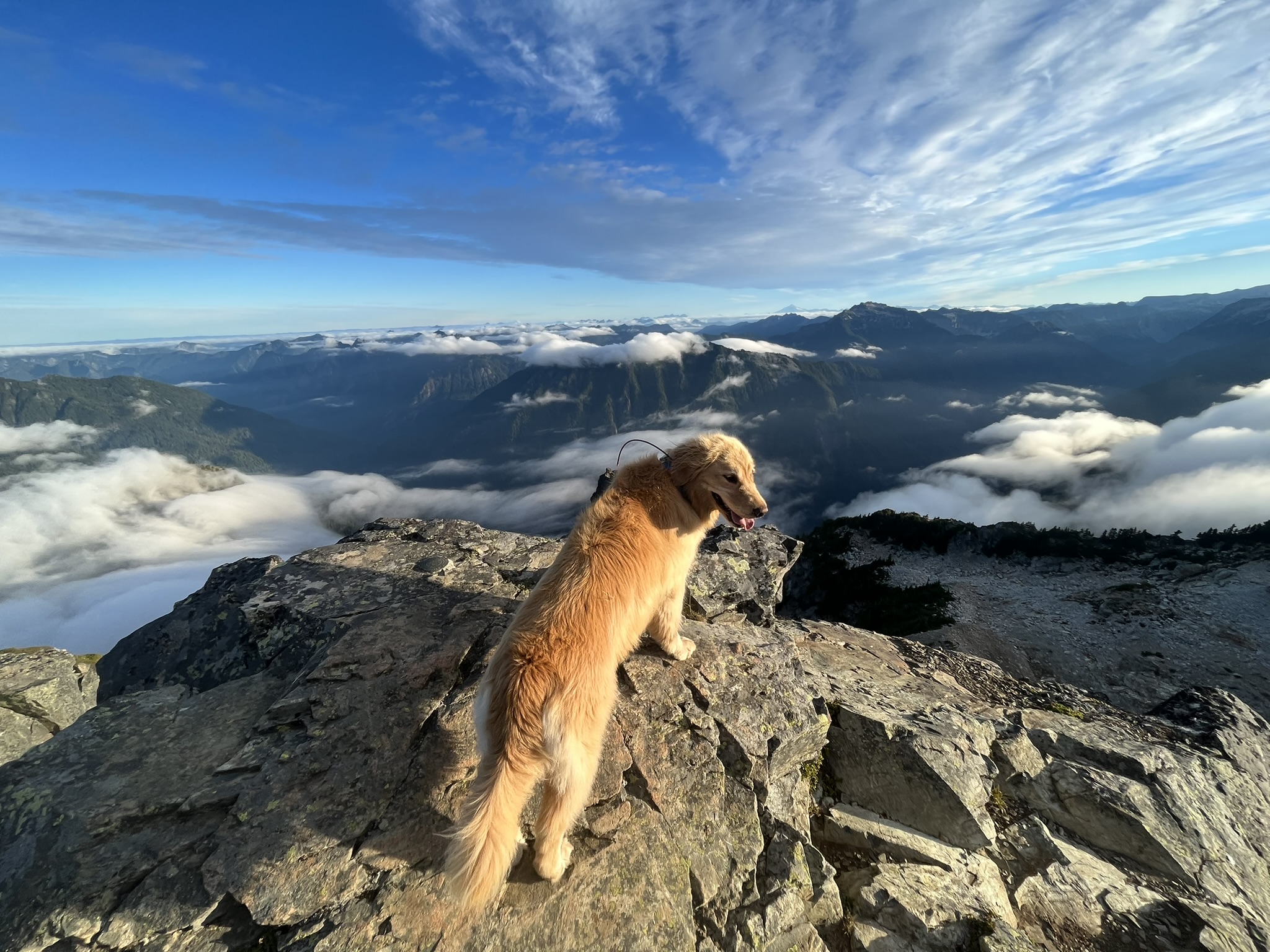
Mount Snoqualmie
A steep Tuesday morning scramble straight up Mount Snoqualmie — 3,175 feet of gain in under two hours, no trail, and a summit above the clouds with Rainier floating on the horizon.
Elevation Profile
Tuesday Morning
My human's alarm went off in the dark. A Tuesday. Normal people go to work on Tuesdays. We went up.
The trailhead at Alpental was empty at 6:20 AM. September morning, 44 degrees, the kind of cold that makes your breath visible and your nose work twice as fast. I could smell wet earth, frost on the subalpine fir, and something faintly metallic — rock dust from the slopes above. The sky was mostly clear. Stars still fading.
There is no trail up Mount Snoqualmie. Not a real one. My human picked a line through steep forest and we started climbing. Straight up. The kind of angle where your front paws are level with your back knees and you stop thinking about distance and start thinking about the next ten feet. I don't mind. Steep means fast, and fast means summit.
The forest was dark and dense and smelled like cedar and decomposing needles. I led, nose down, reading the slope — deer had been through here recently, and something smaller, marmot probably. The ground was soft with duff and then it wasn't. Rock started showing through. The trees got shorter. The air got thinner and colder and I could feel the mountain opening up above us.
Above the Clouds
We broke through the treeline and the world changed. Below us, a solid layer of cloud filled every valley — white and flat and endless, like the mountains were islands. The sun was just clearing the eastern ridges, warm on my face, gold on the rock. The temperature had dropped into the mid-30s but the sun offset it. I wasn't cold. I was electric.
The upper mountain was all rock — loose talus, ledges, slabs tilted at angles that made my human use his hands. I picked my way up through it, four-wheel drive, paws on cold stone. A few patches of old snow lingered in the shadows near the ridge. I stepped across them. They smelled like winter holding on.
Summit — 6,270 Feet
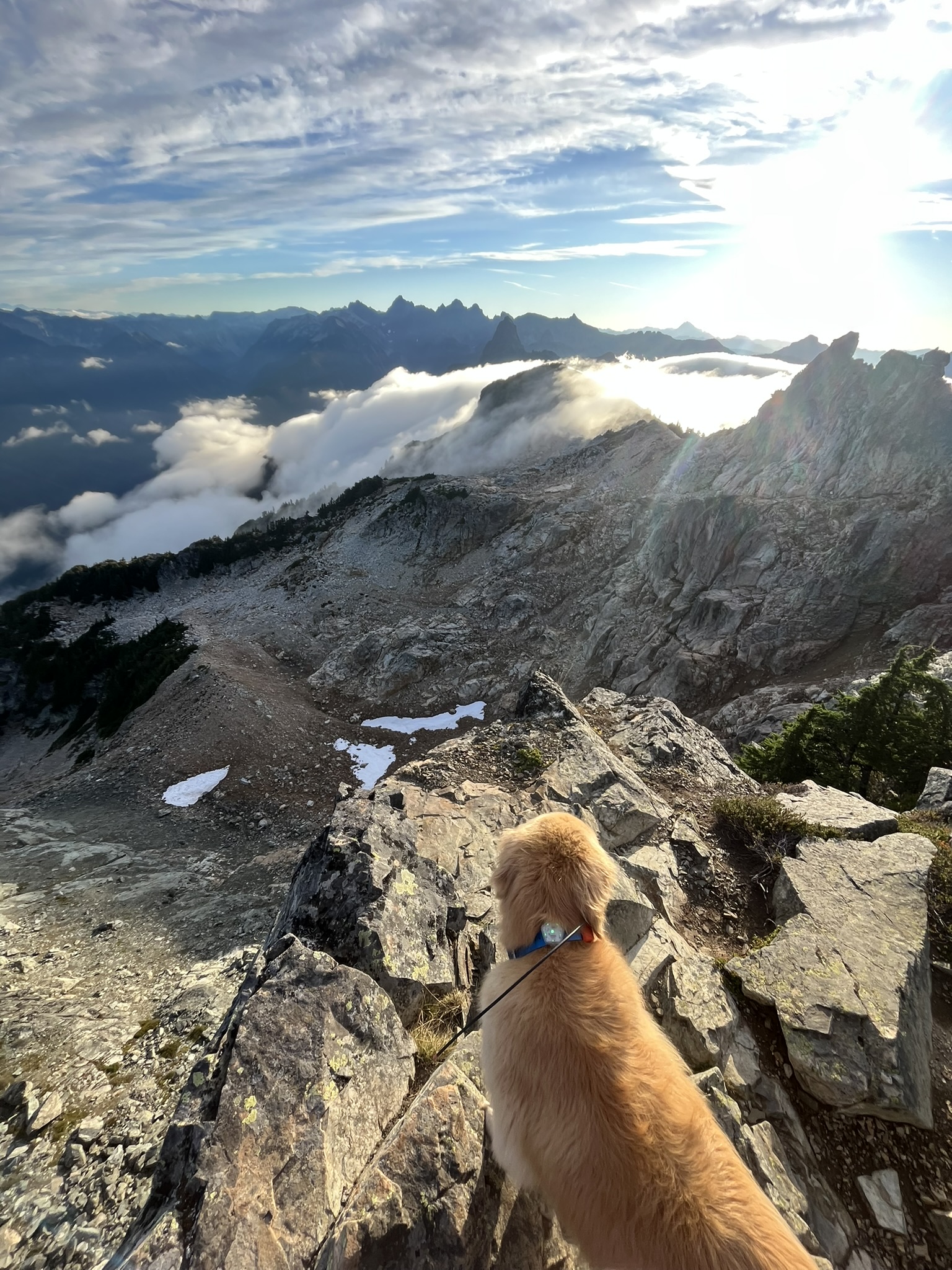
The summit of Mount Snoqualmie is a pile of dark broken rock above a sea of white. I stood on the highest point and looked out at everything. Clouds pooled in the valleys below like water. Ridgelines and peaks rose above them in every direction — sharp, dark, lit by early morning sun. The air smelled like nothing. Clean cold nothing. The kind of air that hasn't touched a tree or a road or a building on its way to your lungs.
I turned and looked north. The Cascades stretched out in a line of jagged granite — spires and ridges and snowfields catching the first real light. The rocky summit ridge fell away steeply below me, gray and tan stone with a few stubborn snow patches clinging to the north-facing pockets. The clouds sat below everything like a second sky.
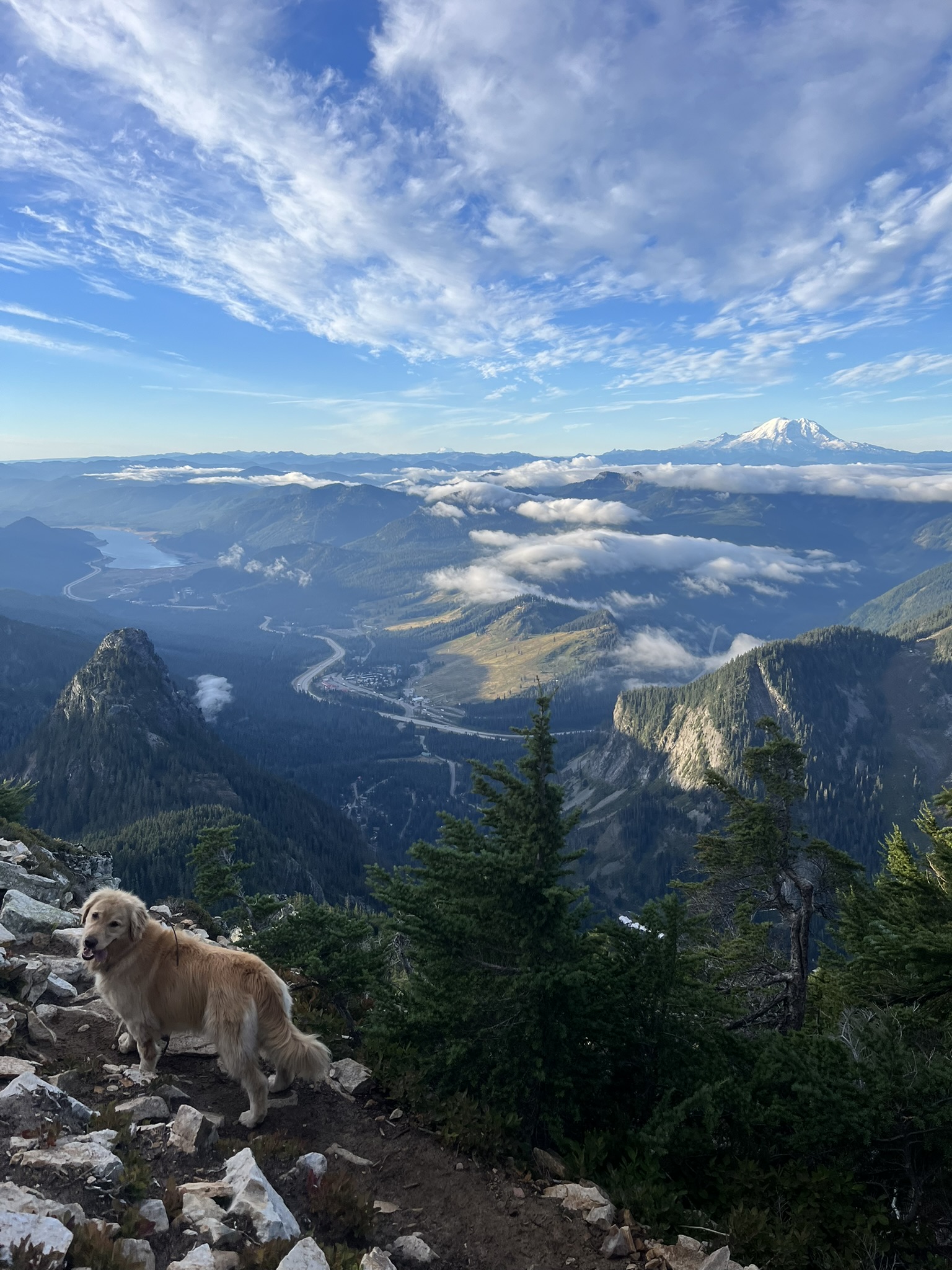
Then I turned south and there it was. Rainier. Floating above the cloud layer like it existed in a different atmosphere. Below it, Keechelus Lake stretched along the I-90 corridor, the valley green and deep, ridgelines stacking into the distance. I stood on loose dirt and rock with a few subalpine trees framing the view. The scale of it — Rainier sixty miles away and still the biggest thing visible — is the kind of thing that makes you sit down and just look.
Down
We didn't stay long. The clouds were building and the summit had given us everything it had. Down is faster than up — gravity does most of the work and I just have to keep my paws under me on the loose rock. We reversed the route, dropped back through the talus, back into the trees, back to the trailhead. Two hours and six minutes, car to car. My human went to work. I went to sleep.
Three photos, no trail, one summit above the clouds on a Tuesday morning. Not every hike needs to be an expedition. Some just need to be vertical.