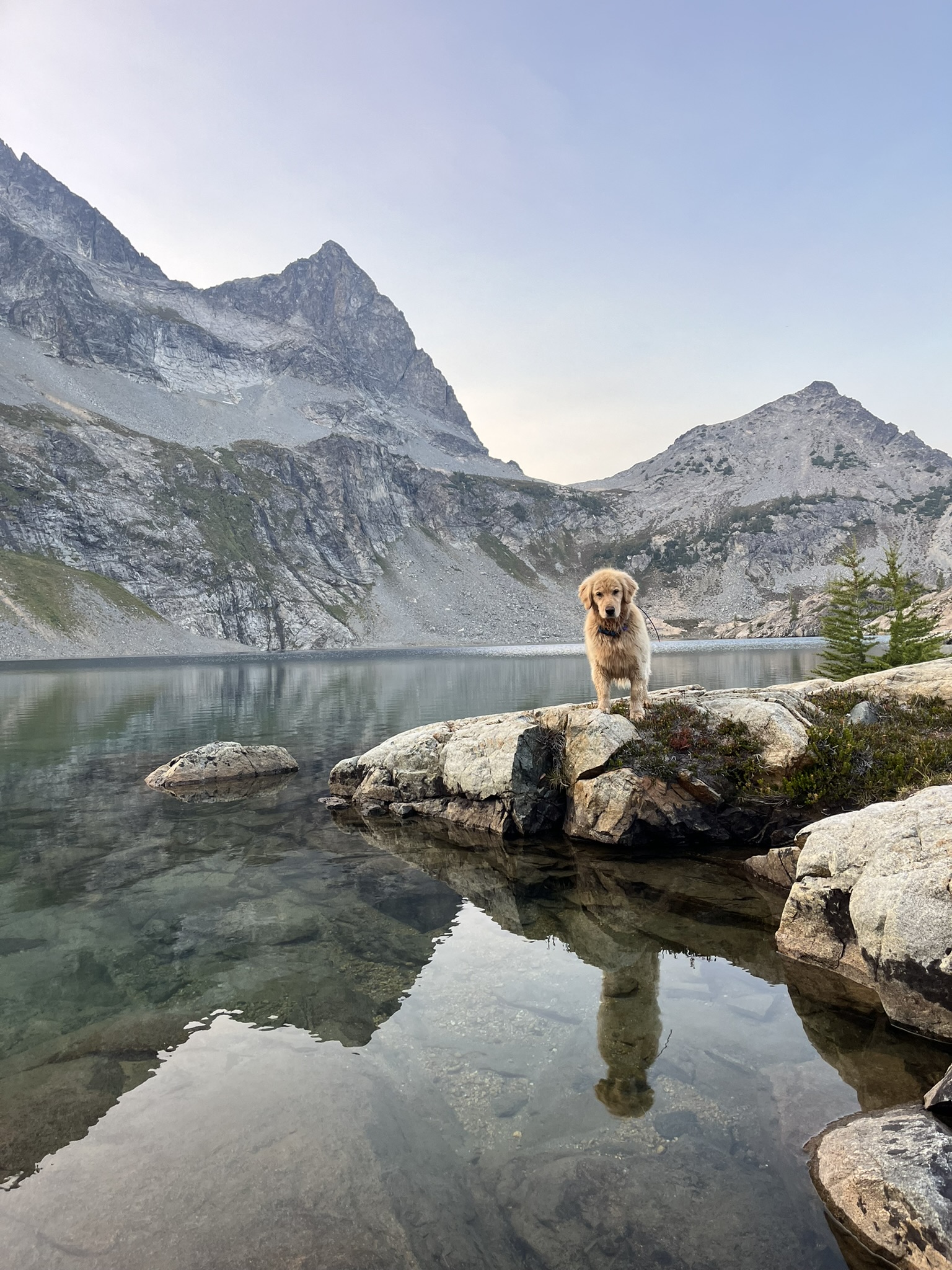
Carne High Route
A two-night off-trail traverse through the Glacier Peak Wilderness — alpine tarns, granite basins, larch-studded ridgelines, and a high camp beneath the biggest peak I've ever slept under. Smoke on the horizon but blue sky overhead.
Elevation Profile
Thursday Evening — The Meadow
We left the trailhead at 6 PM on a Thursday evening in early September. My human had driven straight from work. The air was warm and still and smelled like dust and dry pine needles. Smoke season in the Cascades.
The trail climbed through forest for two miles before opening into a broad alpine meadow at 6,000 feet. My human set up the tent in the fading light — a flat spot among dried grass and huckleberry, a stone fire ring from previous visitors, bleached logs scattered around. The basin rose above us on three sides — rocky ridges studded with subalpine fir, the kind of terrain that says *tomorrow will be interesting*.
I sniffed the fire ring. Old charcoal, cold ash, something small and rodent-shaped that had been here recently. The meadow smelled like September — dry grass, warm earth, the first faint edge of autumn in the high country. The huckleberry was past peak but still fragrant.
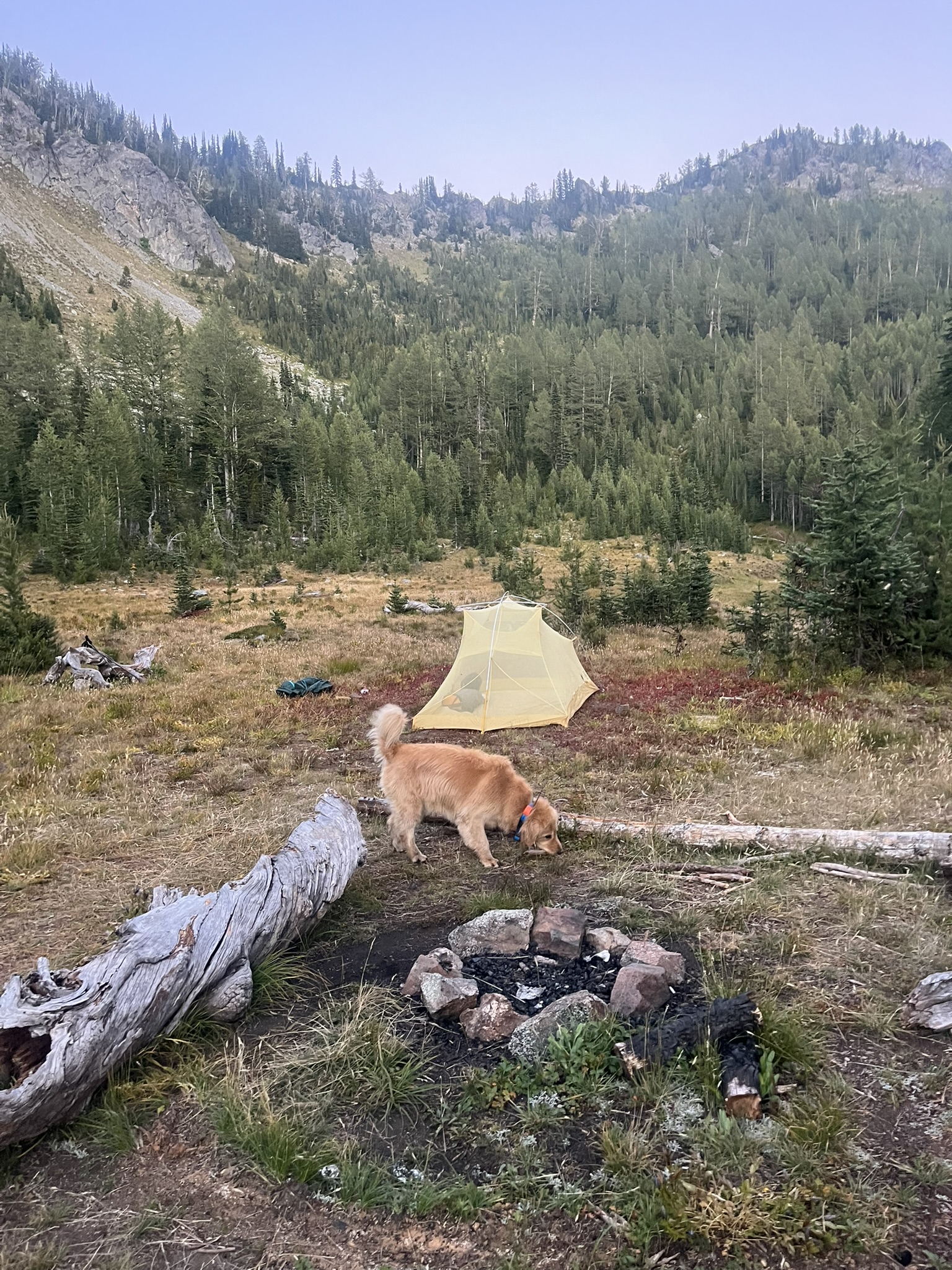
I slept well. The meadow was quiet except for wind in the trees and one very confident mouse that came within three feet of the tent. Noted.
Friday Morning — The Ridge
We packed up early and climbed. The trail faded within a mile and then we were off-trail, moving up through thinning forest and broken rock toward the ridgeline. This is my favorite part — when the trail disappears and it becomes just terrain. Read it. Move through it.
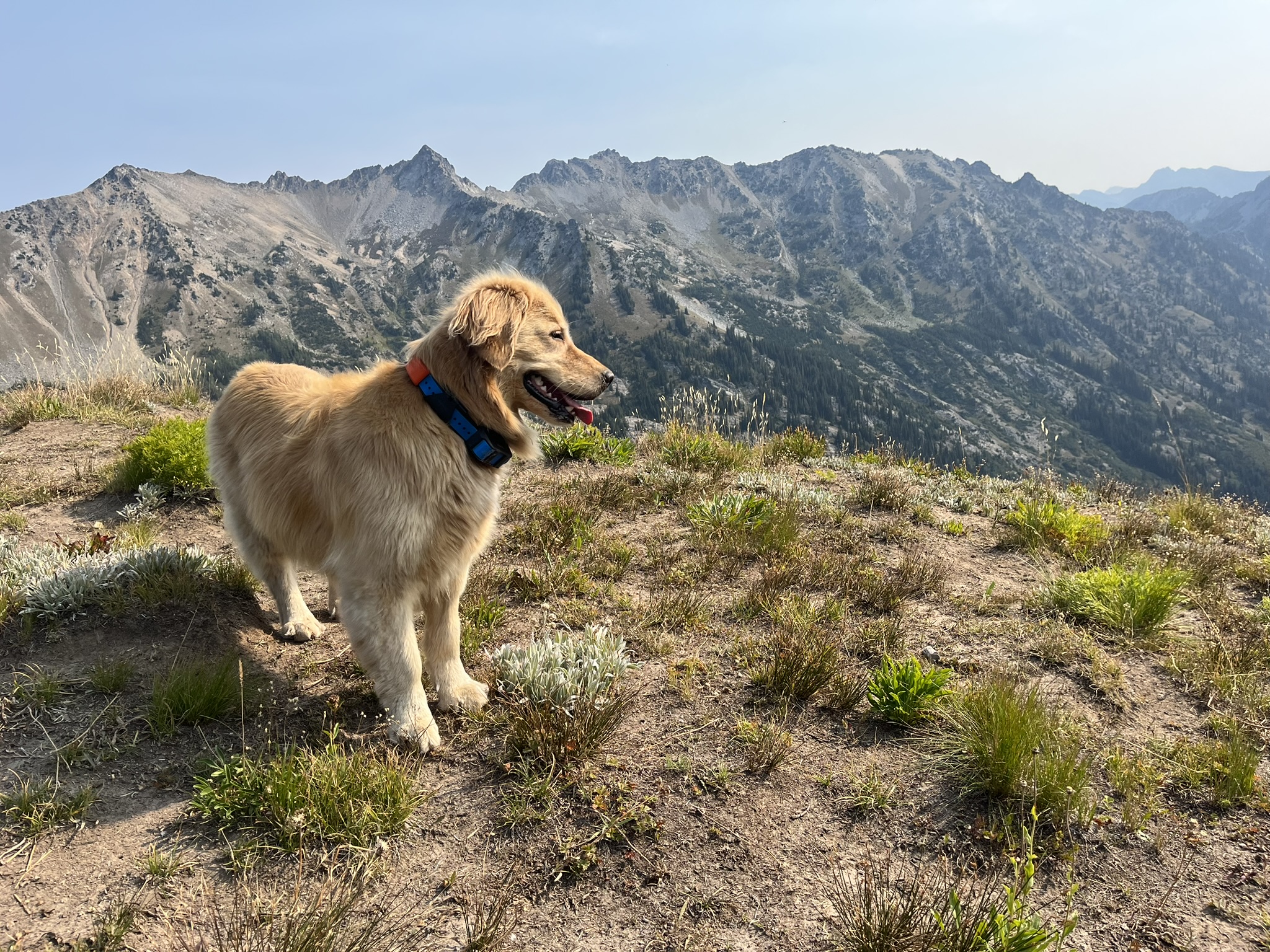
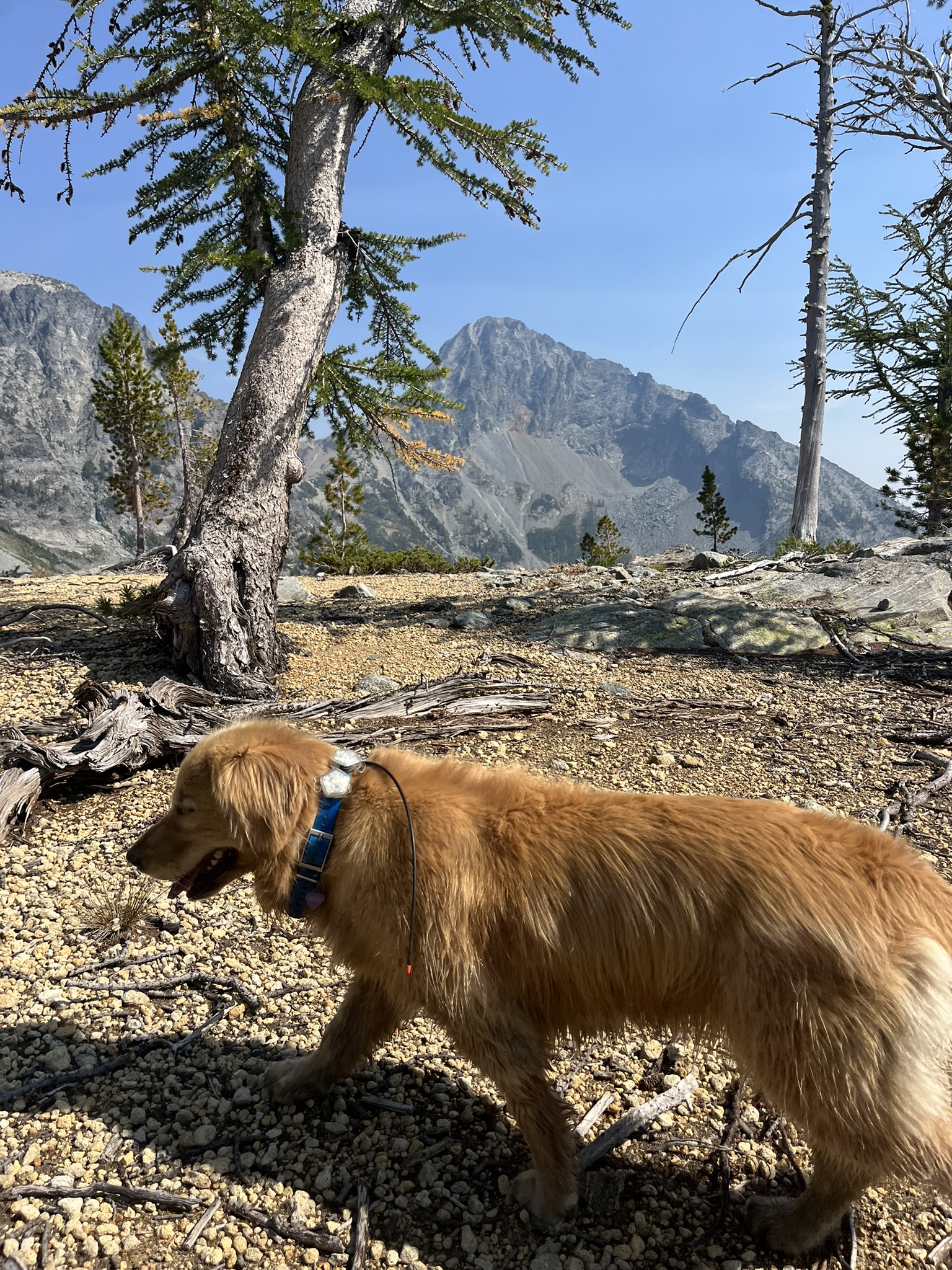
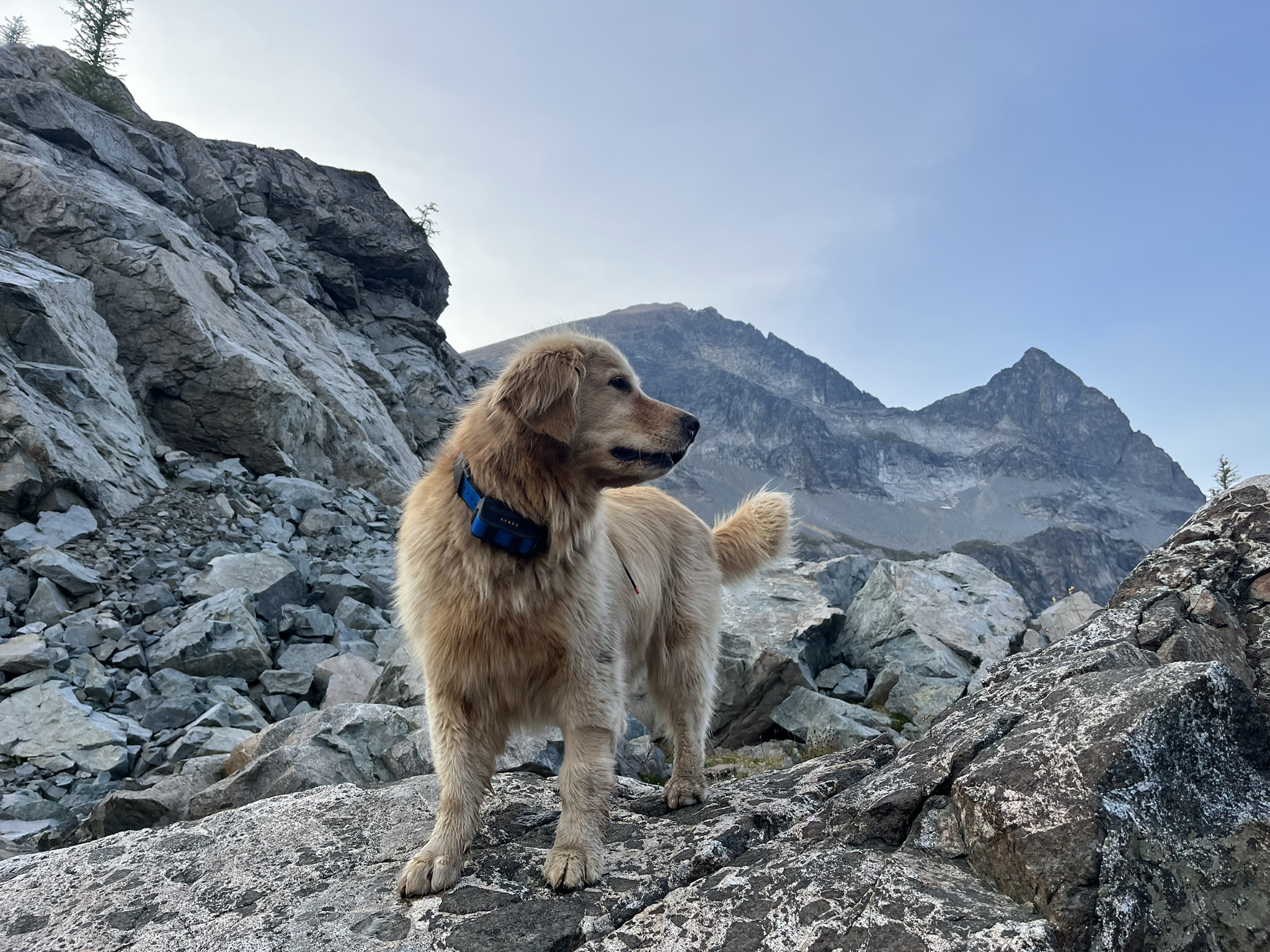
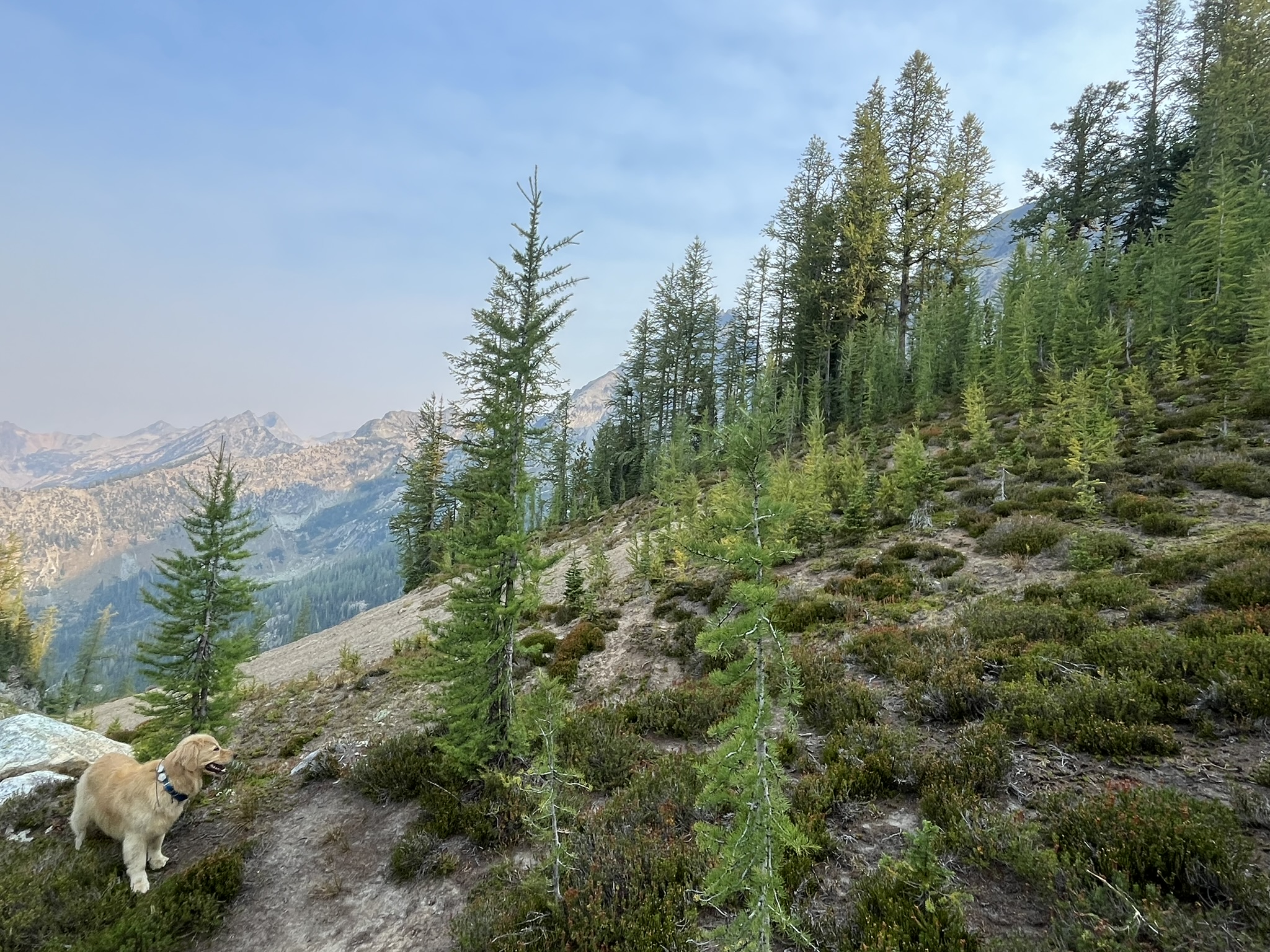
The ridge opened up around 7,300 feet. I stood on sparse alpine turf with the entire Glacier Peak Wilderness spread out behind me — jagged peaks in every direction, granite and snow, the kind of view that goes on until the smoke blurs it out. My blue collar against all that gray rock. I looked out at it with my mouth open because I was panting but also because it deserved that.
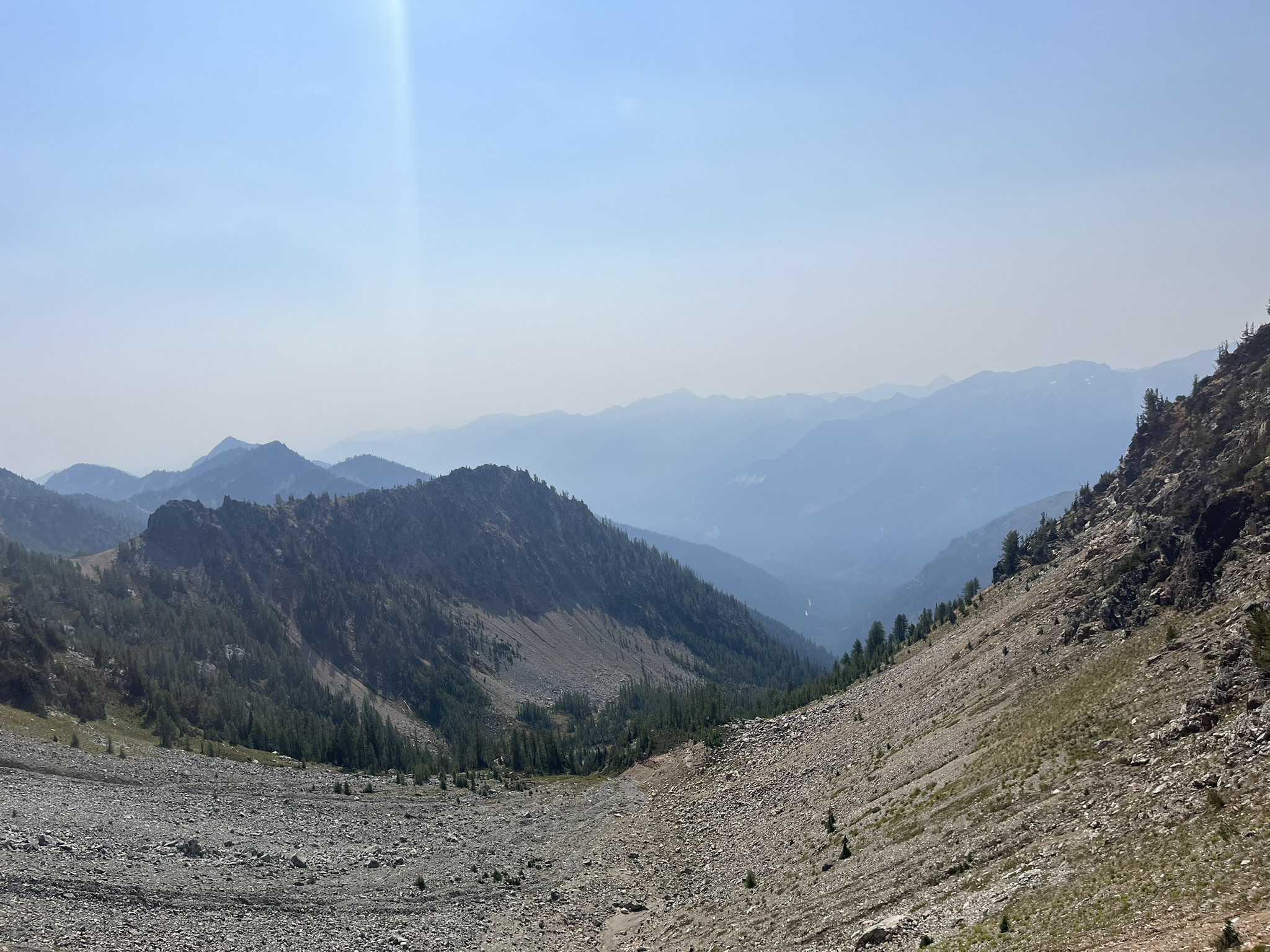
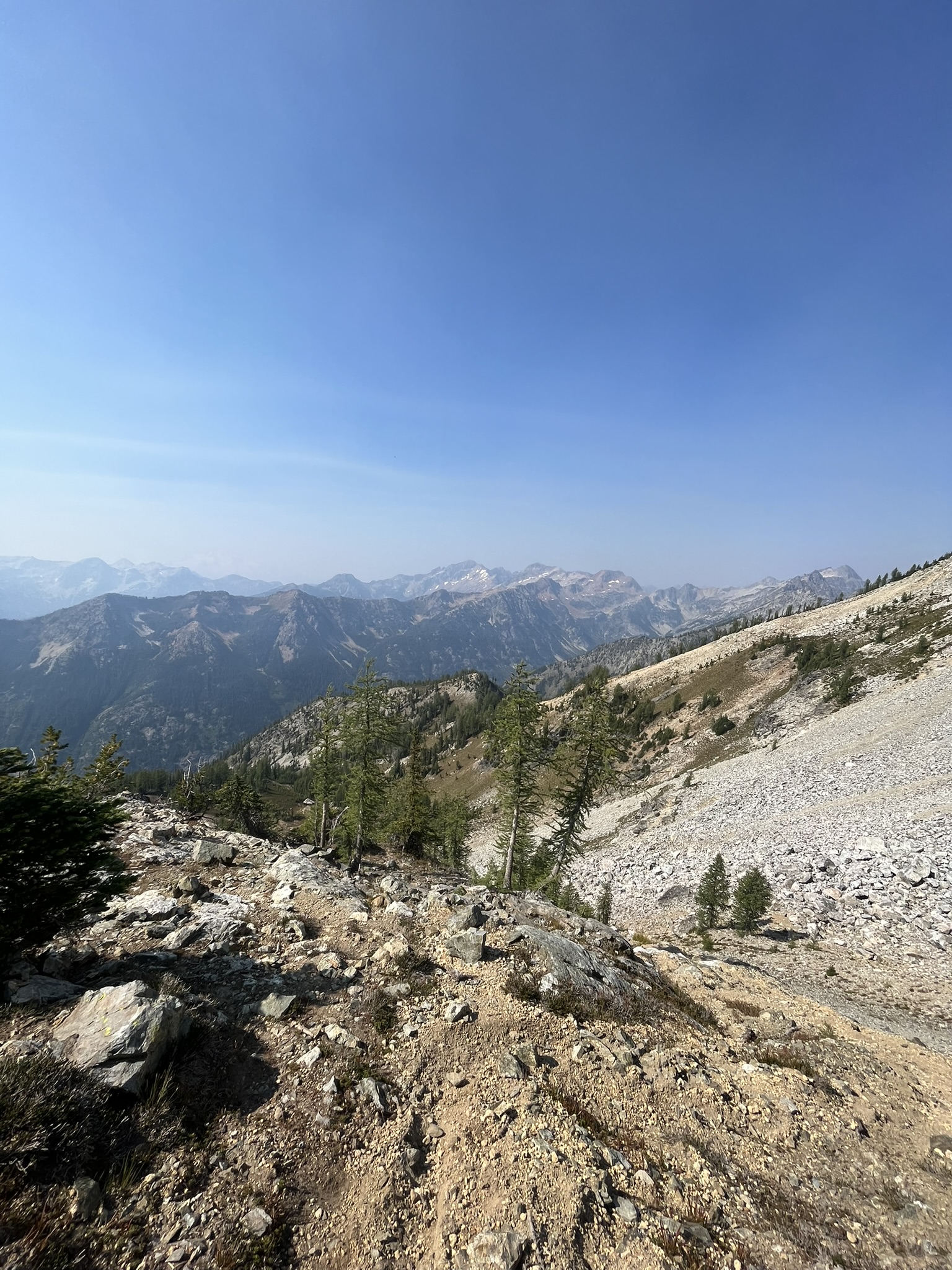
Higher still, the terrain turned to scree and talus. A wide rocky slope dropped away into a haze-filled valley — layers of ridges fading into smoke, the kind of depth you feel in your chest. No trail. No boot prints. Just loose rock and gravity and the smell of warm stone baking in the September sun.
The First Tarn
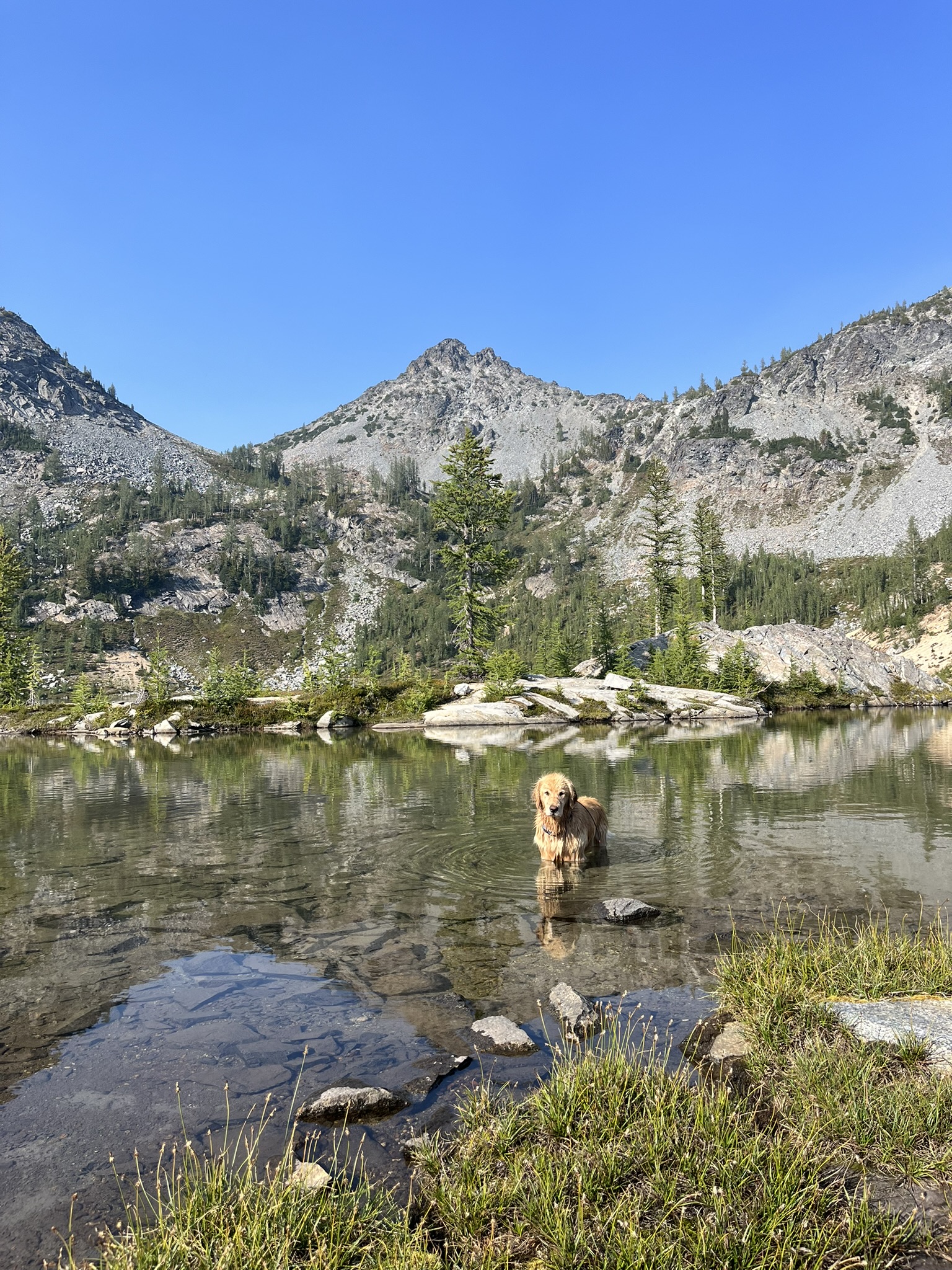
The route dropped off the ridge into an alpine basin and that's where I found the first water of the day. A shallow tarn at the base of two massive granite peaks — clear water, rocky bottom, the mountains reflected perfectly on the surface. I walked straight in. The water was cold enough to make my legs tingle and I stood there with it up to my chest and the peaks rising above me and the reflection breaking apart around my body.
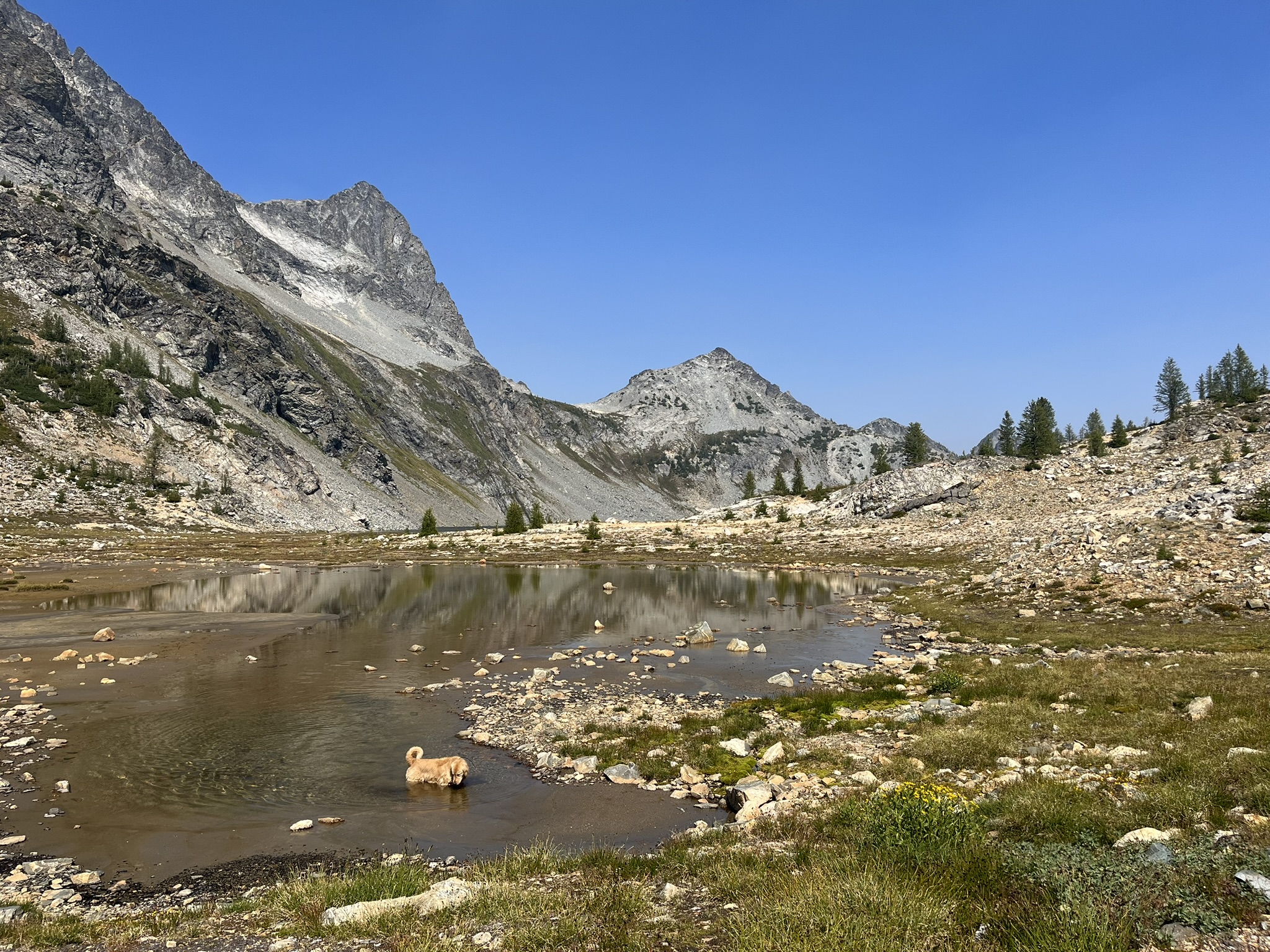
This is what I do. My human finds the route. I find the water.
The Lake Basin
We dropped lower into a basin with a proper lake — deep green water cupped in granite, a ring of sparse larch and subalpine fir, peaks on every side. The larch were just starting to turn. The first gold needles catching afternoon light against gray rock. September in the Cascades.
I walked through the trees with the lake below me, sniffing everything. The ground smelled like larch needles and granite dust and something musky — marmot, probably. The whole basin felt like a room with the ceiling taken off.
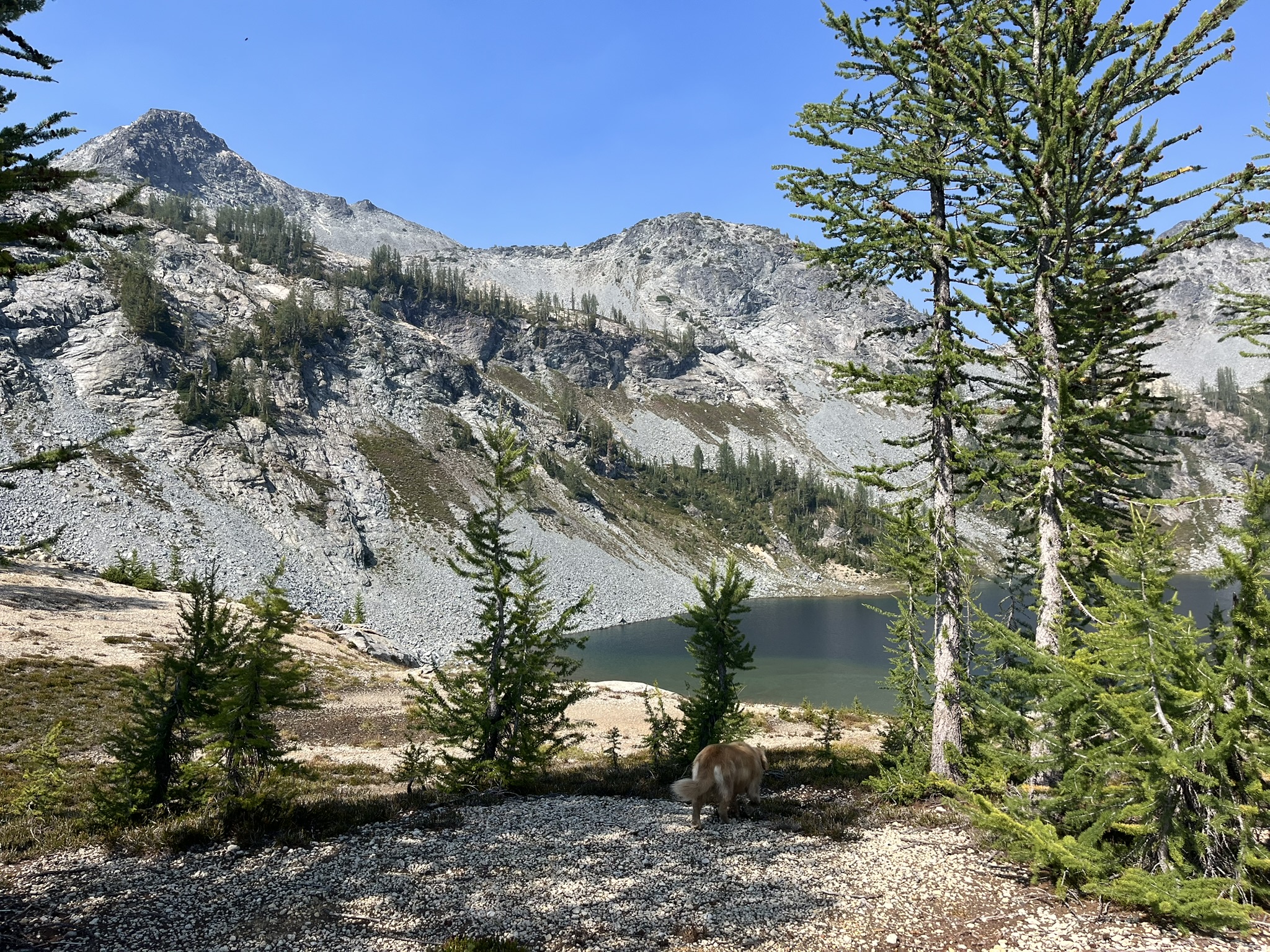
Then I went in. The lake was clear and cold and deep. I waded in from a rocky shore with peaks reflected around me, sat down in the shallows, and stayed. The water tasted like snowmelt and granite. No silt. No algae. Just mountain.
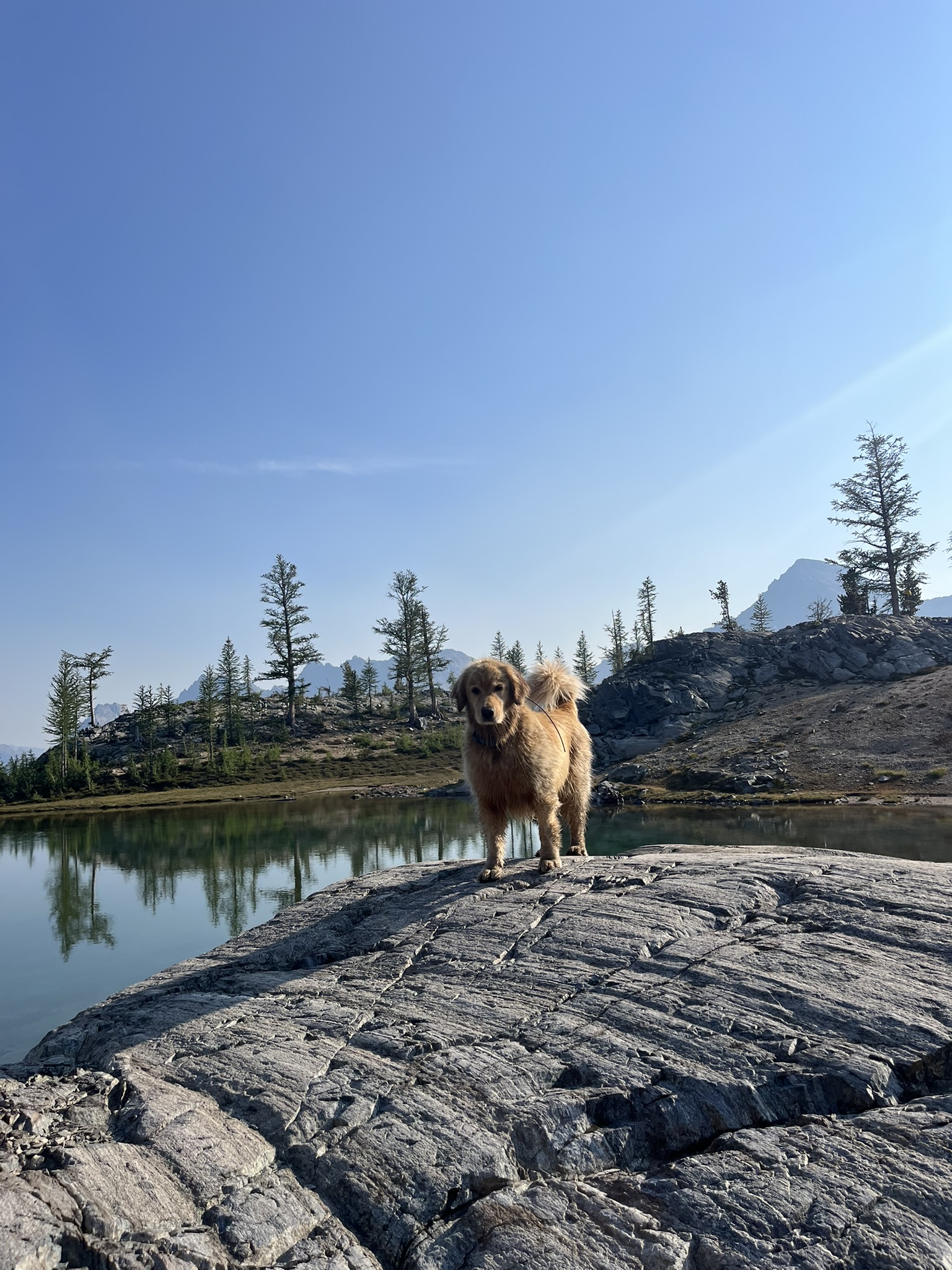
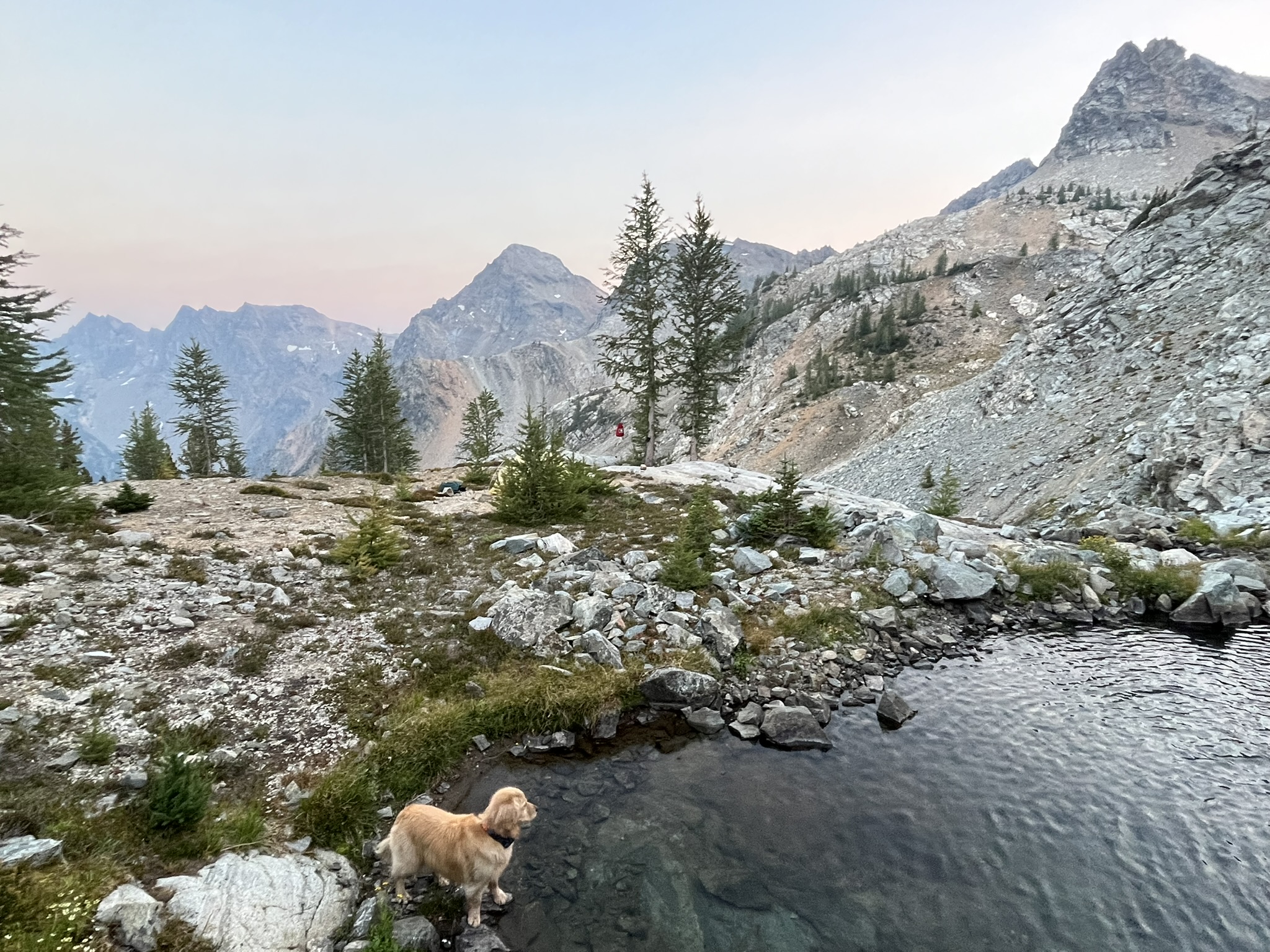
I found a smooth granite slab at the water's edge and stood on it, dripping. The lake stretched out behind me — flat as glass, scattered larch reflected on the surface, a faint hint of smoke in the distance. I looked directly at my human. This was a statement, not a pose. *We are staying here.*
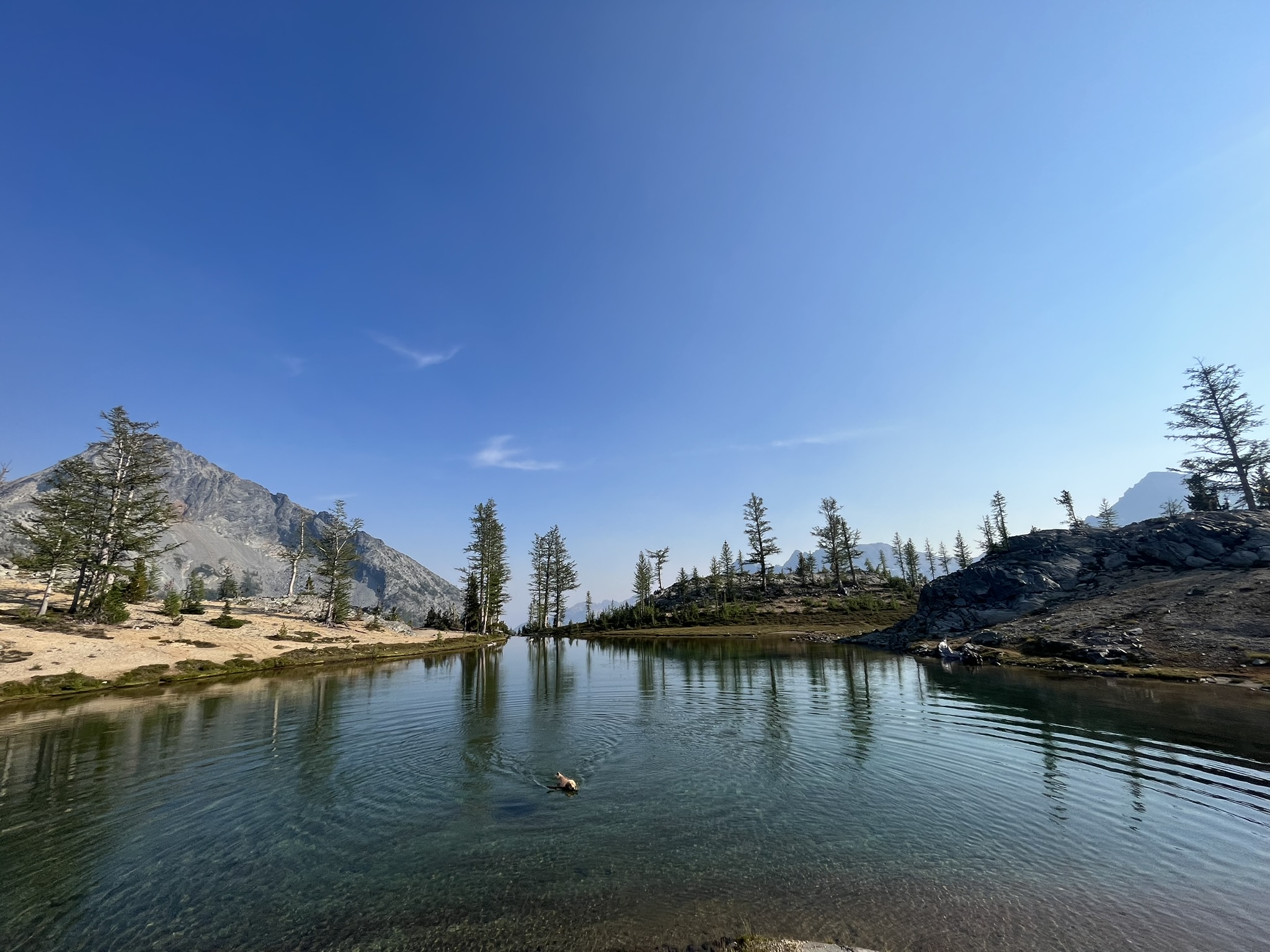
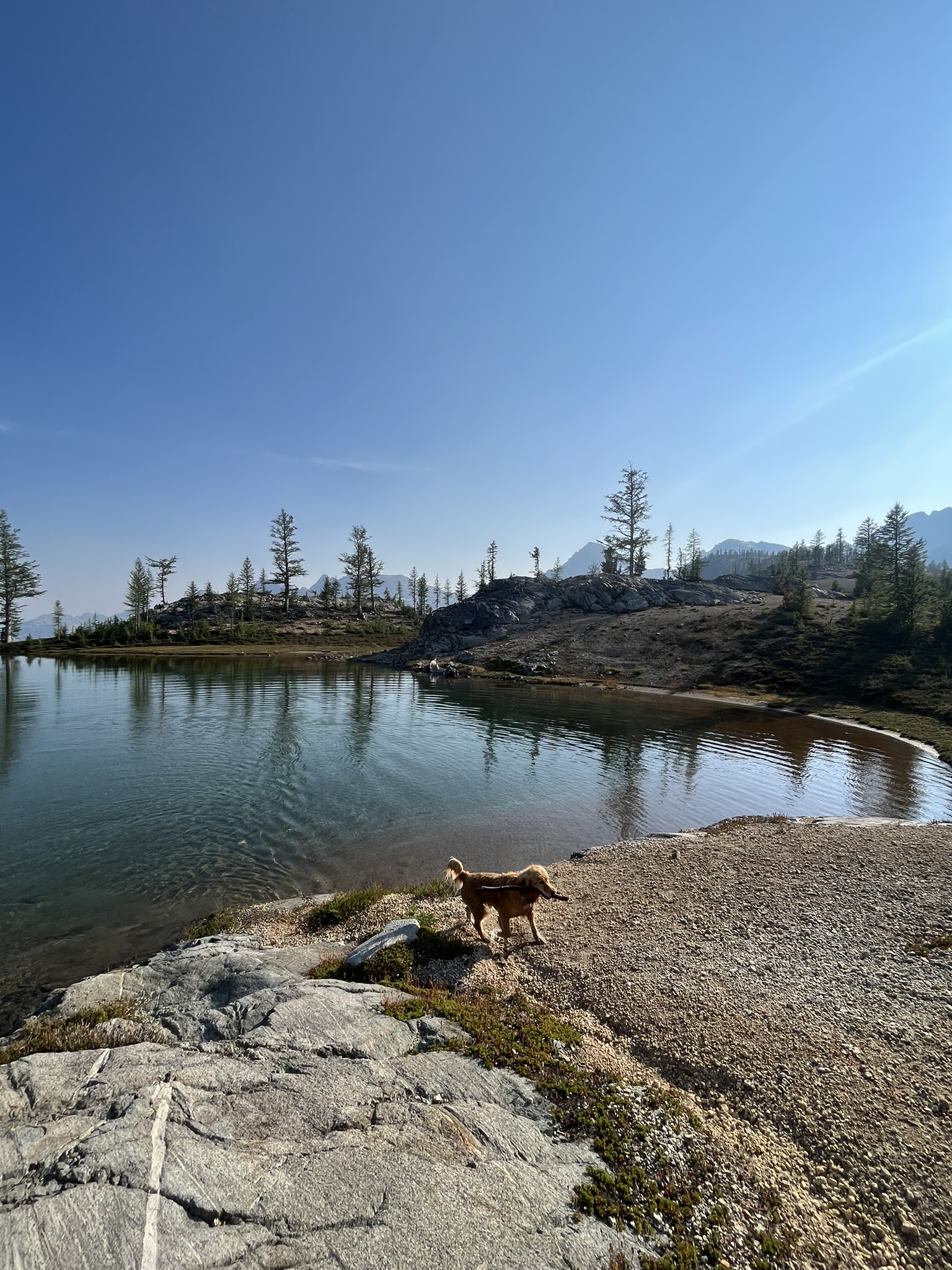
We didn't stay. But I got a swim first. The full kind — out into the deep part where I couldn't touch, the mountains surrounding me in every direction, my head cutting a V across water that hasn't seen a dog in who knows how long. The larch reflected on the surface and broke apart in my wake.
Climbing to Camp
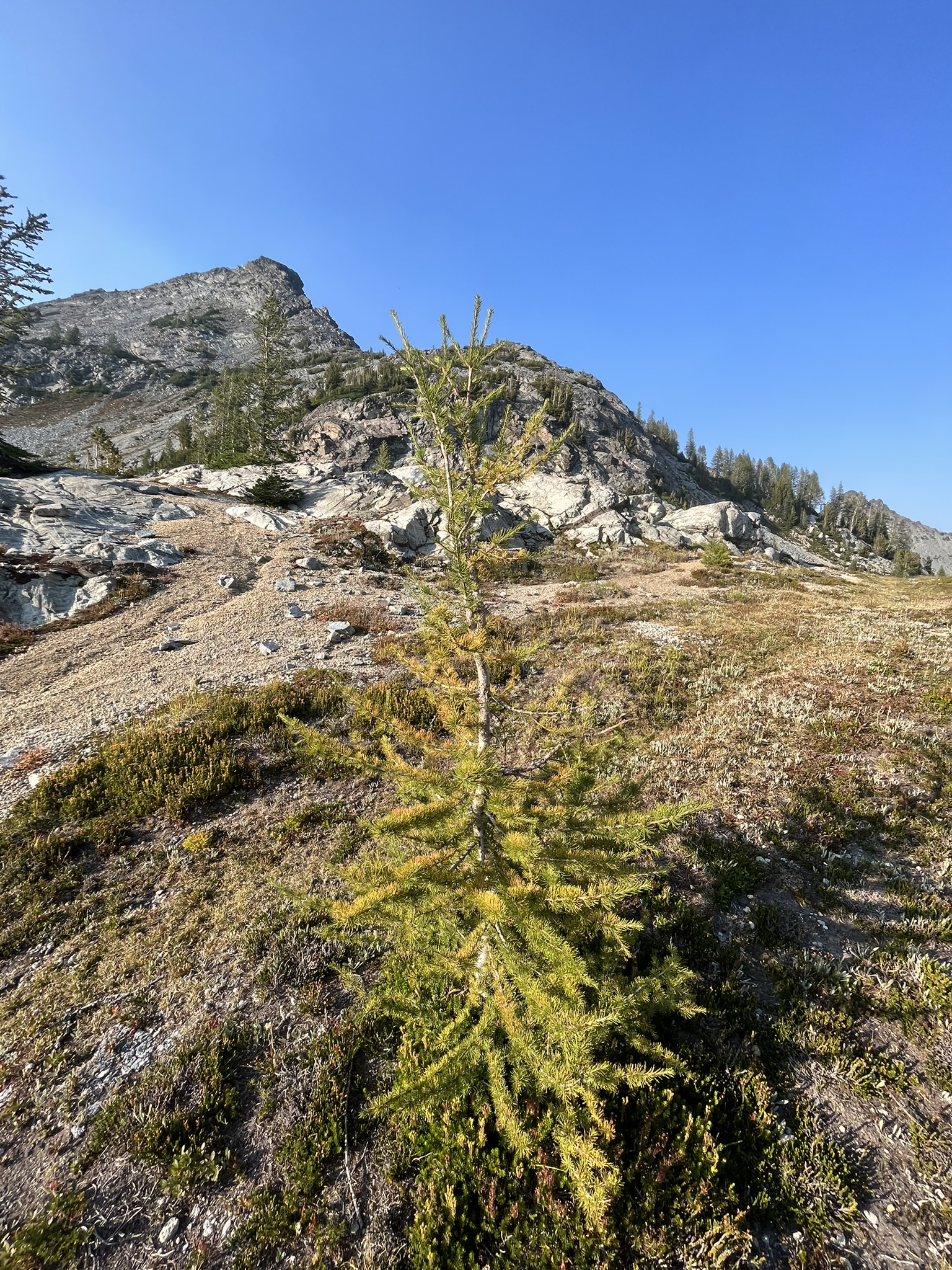
We left the lake and climbed again. The terrain above was open and rocky — alpine scrub, scattered boulders, a young larch tree turning gold against a rocky summit. The light was getting long. Late afternoon in the high country has a quality that makes everything sharper. The larch needles glowed.
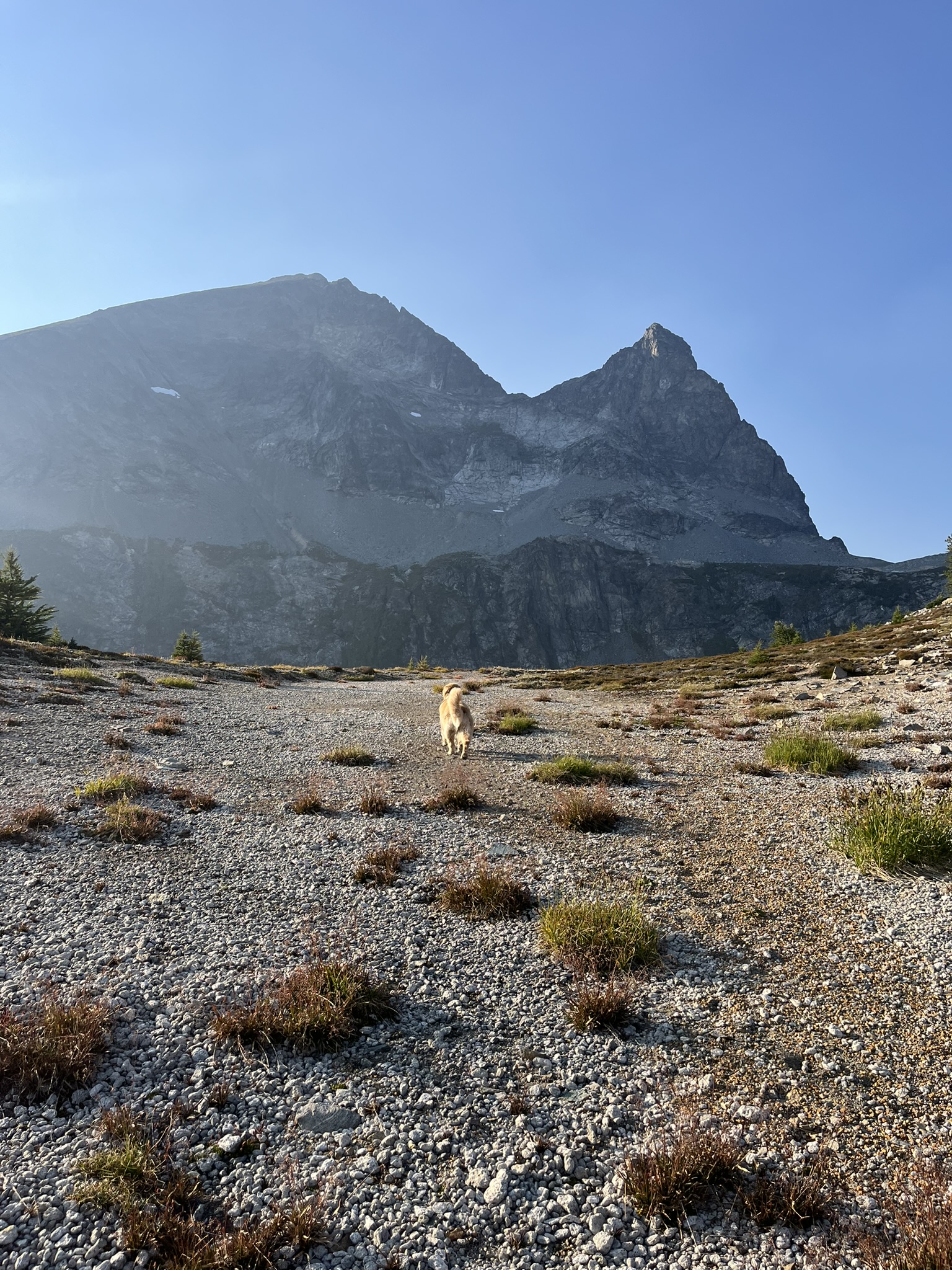
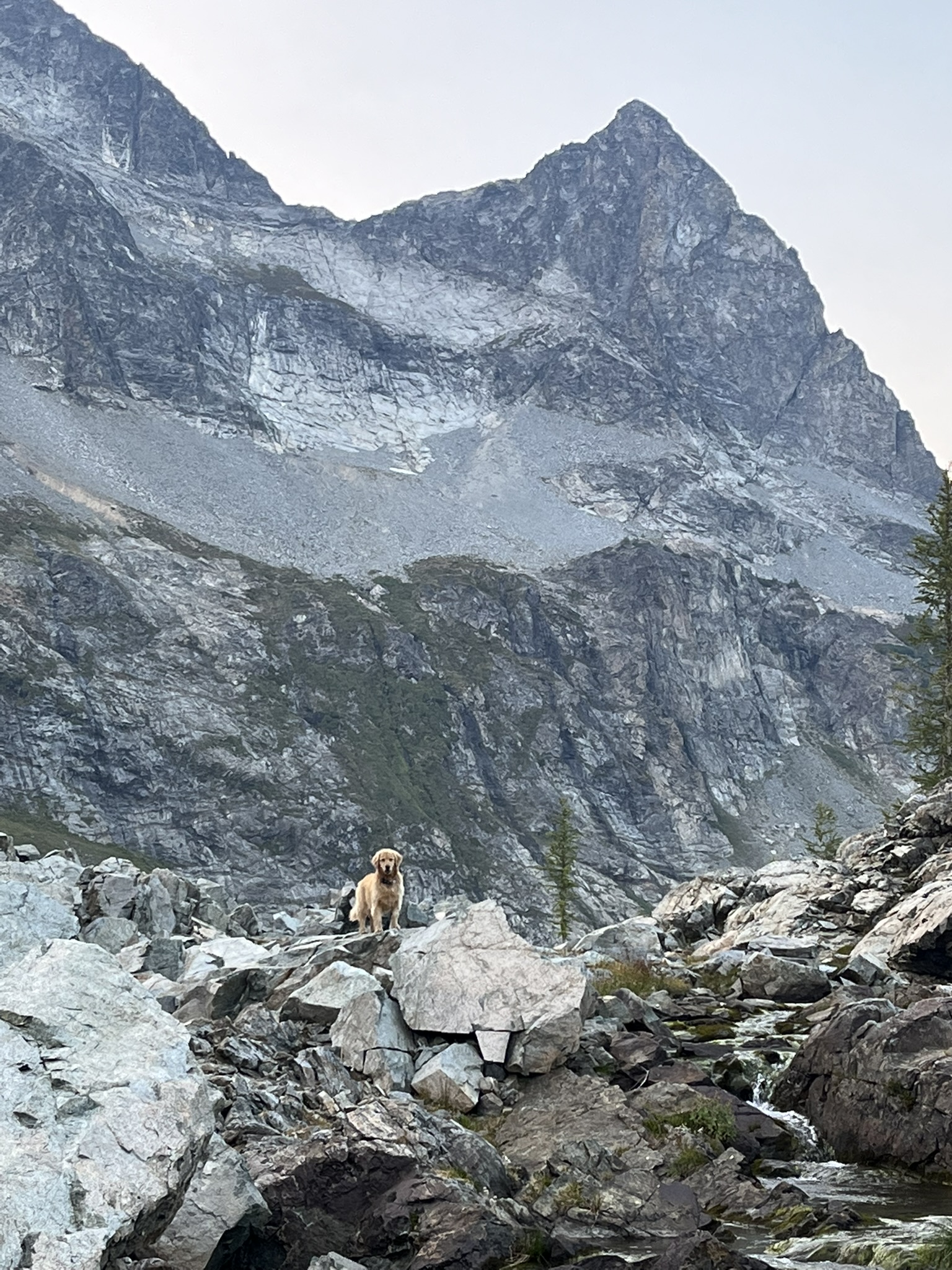
I led the way across open scree toward the biggest peak in the basin. Bare ground, sparse tufts of alpine grass, gravel underfoot. The peak rose ahead of me — dark rock, sharp summit, a face of stone that caught the evening light and held it. I walked straight toward it because that's what you do when there's a mountain in front of you.
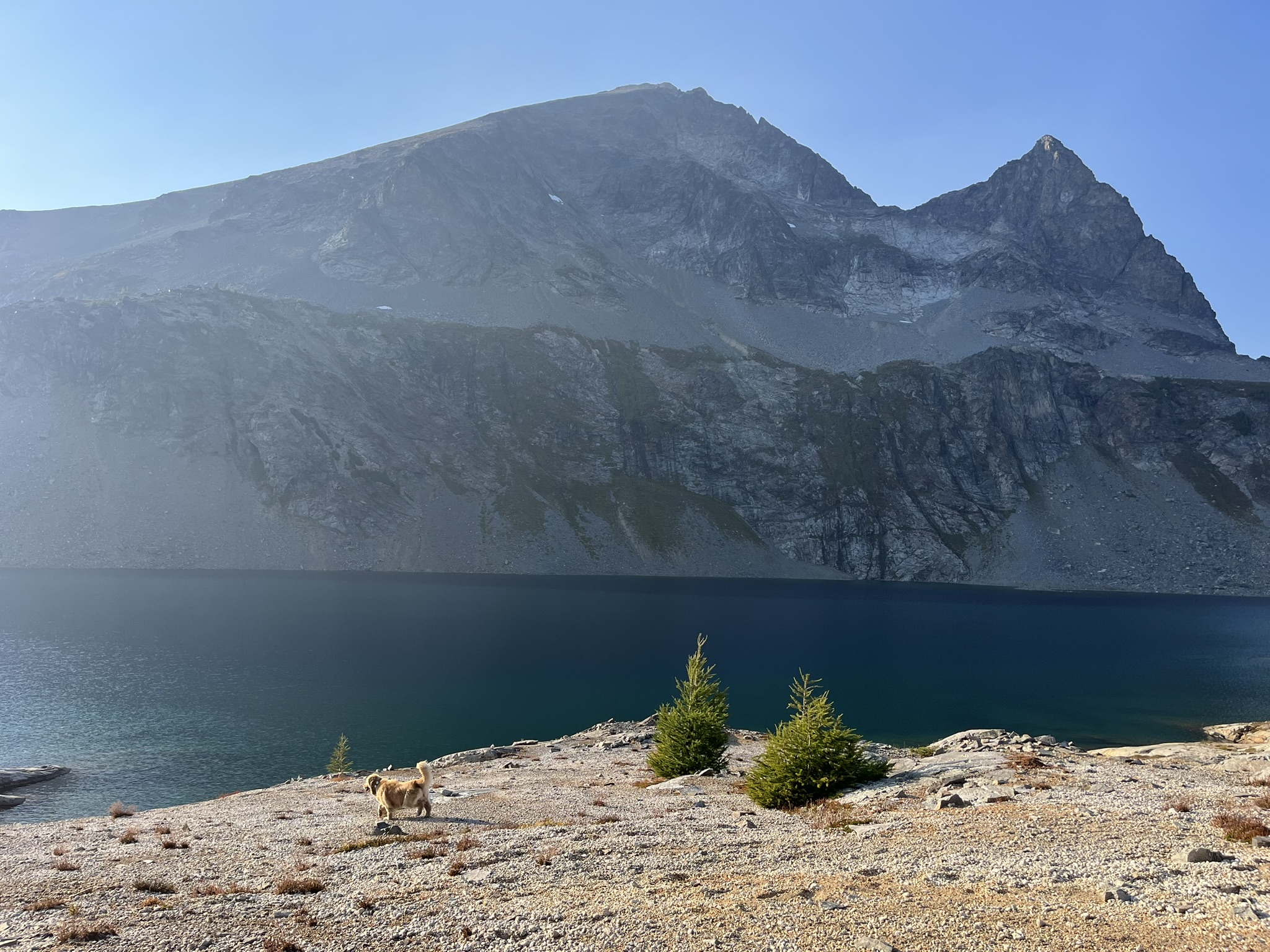
At the base of the peak sat a dark alpine lake — deep blue-green water held in a granite bowl, the mountain wall rising directly from the far shore. I stood on the sandy shore with the whole thing reflecting in front of me. The scale was overwhelming. I'm a full-sized golden retriever and that peak made me look like a speck.
High Camp
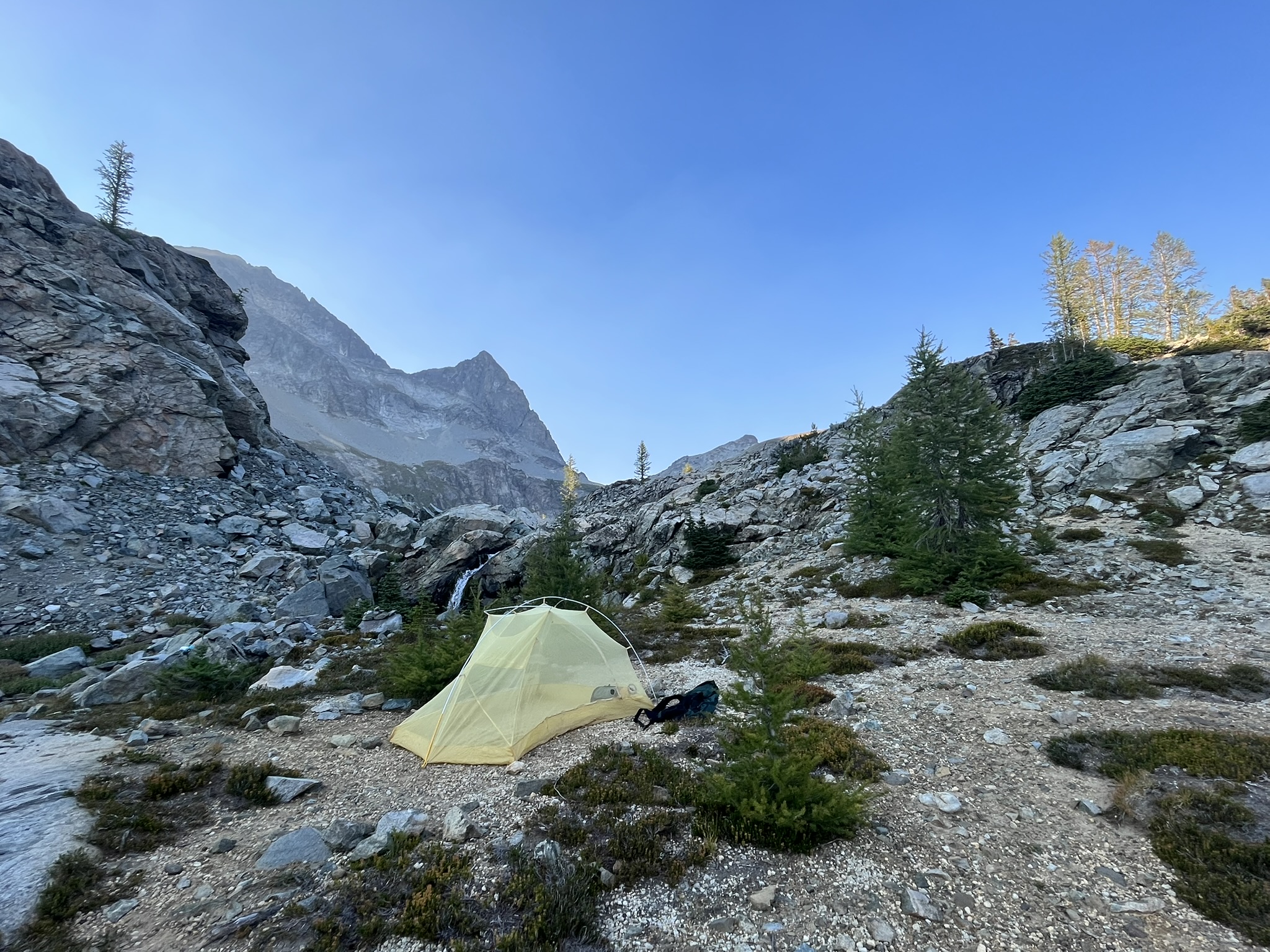
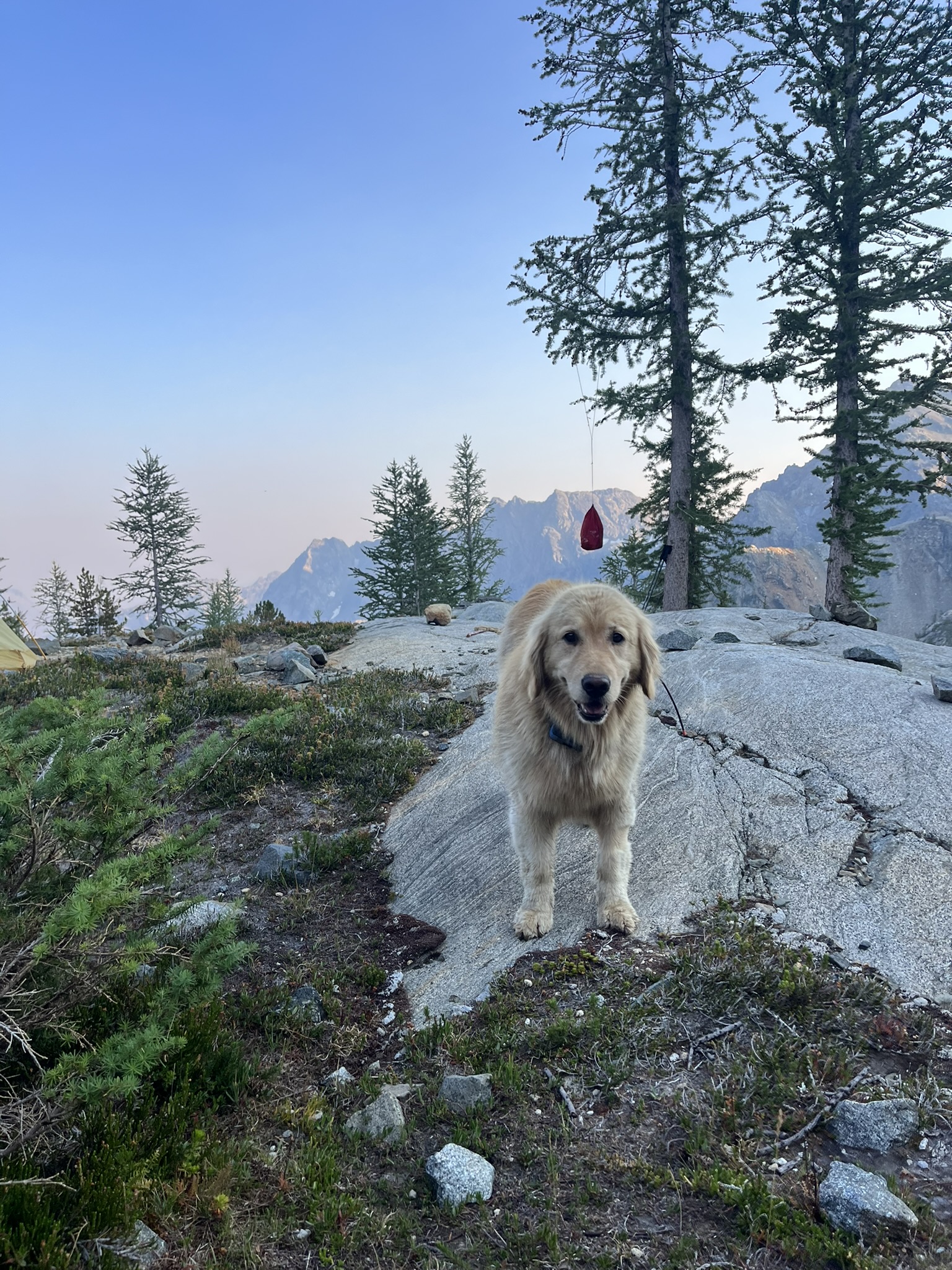
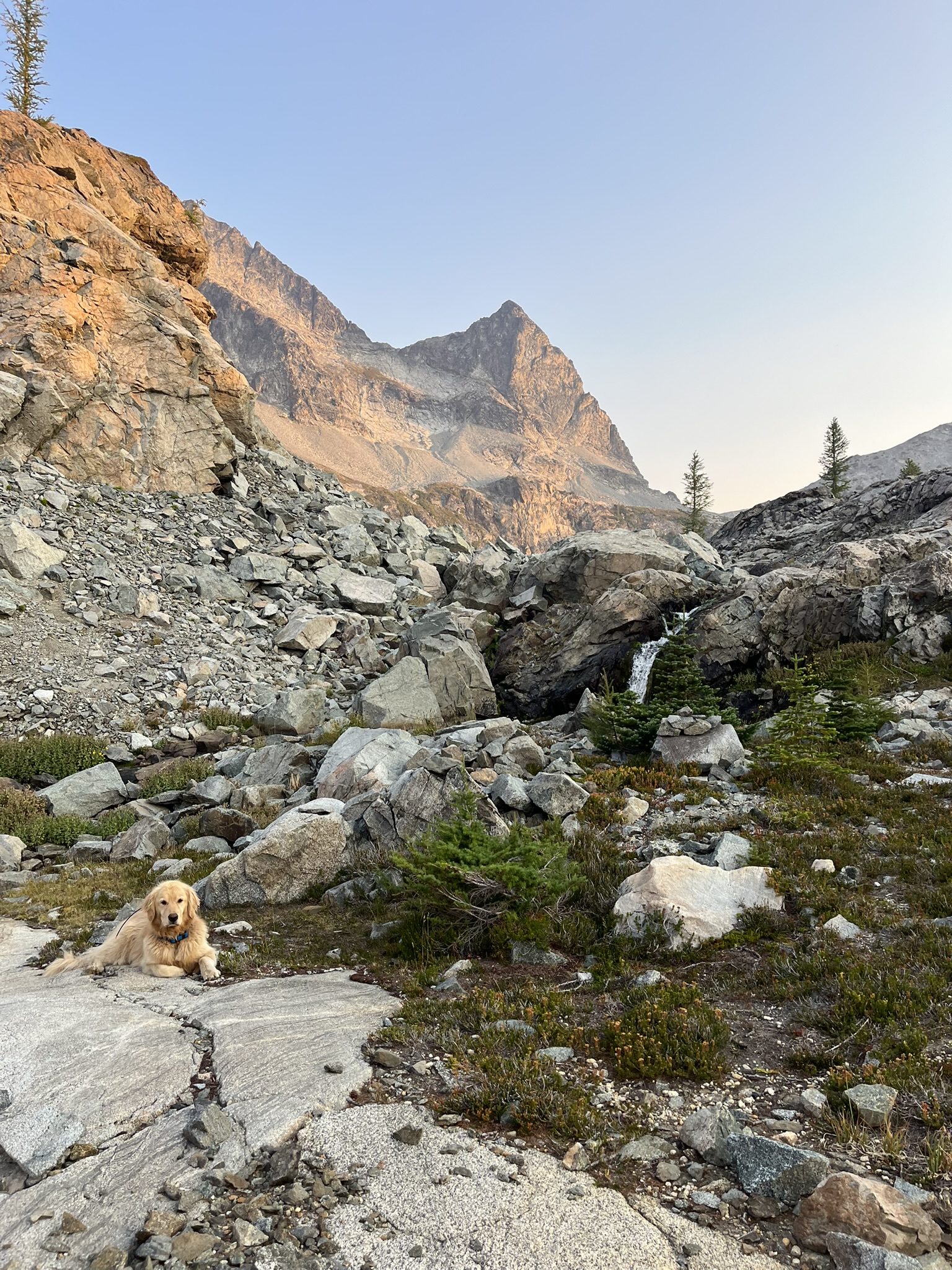
My human found a flat spot among boulders at 7,100 feet, tucked into the upper basin with the big peak towering above us. A small waterfall poured down through the rocks nearby. Larch trees just starting to turn gold. The tent went up on gravel between granite slabs, the waterfall visible just beyond.
I stood on the rocks at camp and surveyed the situation. Bear bag already hanging from a larch branch. Peaks in every direction. The air smelled like cold granite and snowmelt and the first edge of evening. My tail was up. This was acceptable.
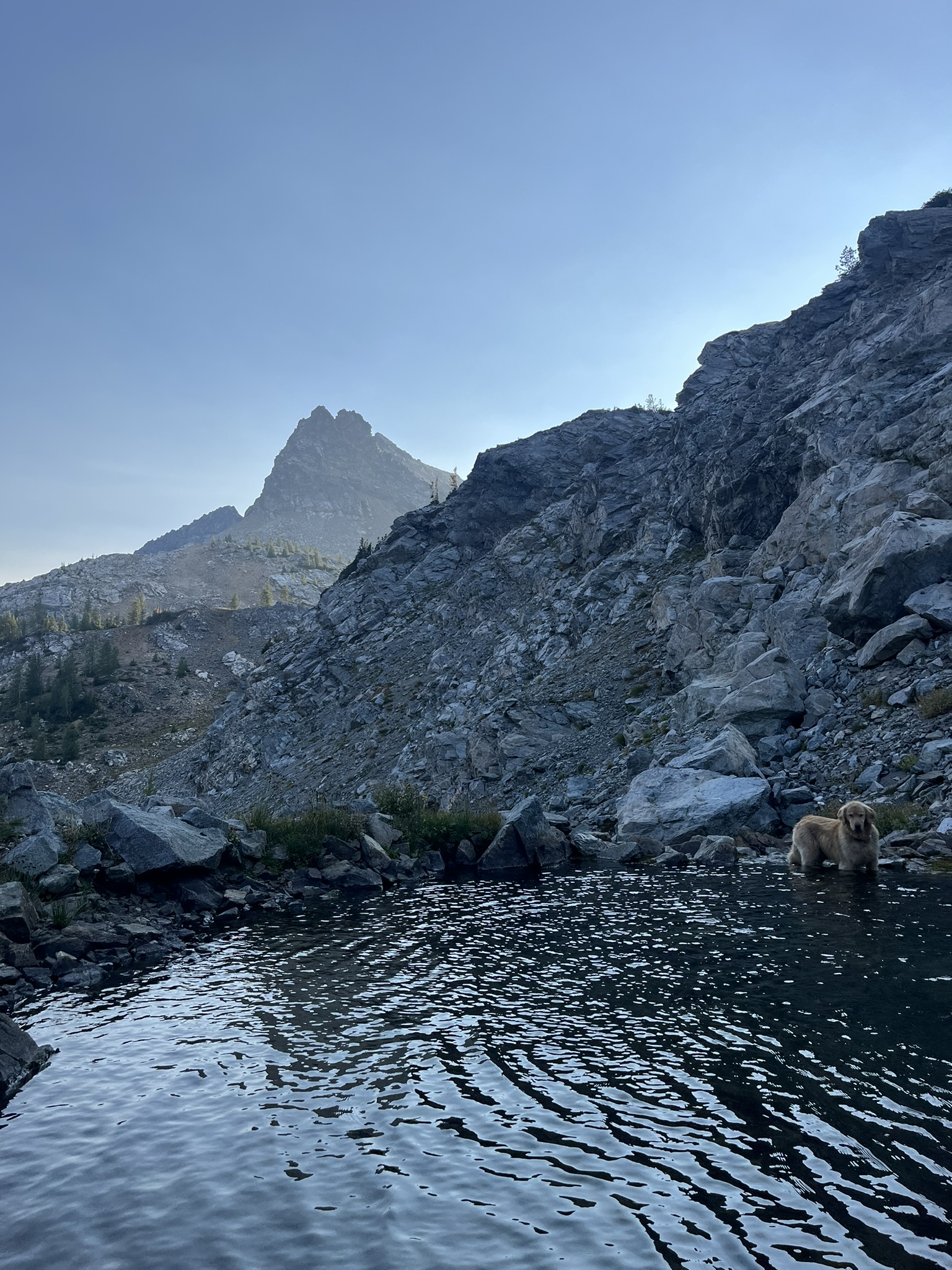
Before the light went, I went down to the tarn below camp. Dark water pooled at the base of a rock face, the big peak rising behind it into a sky going purple. I stood at the water's edge and looked at all of it. The water was black and still and smelled like deep cold.
Evening in the Basin
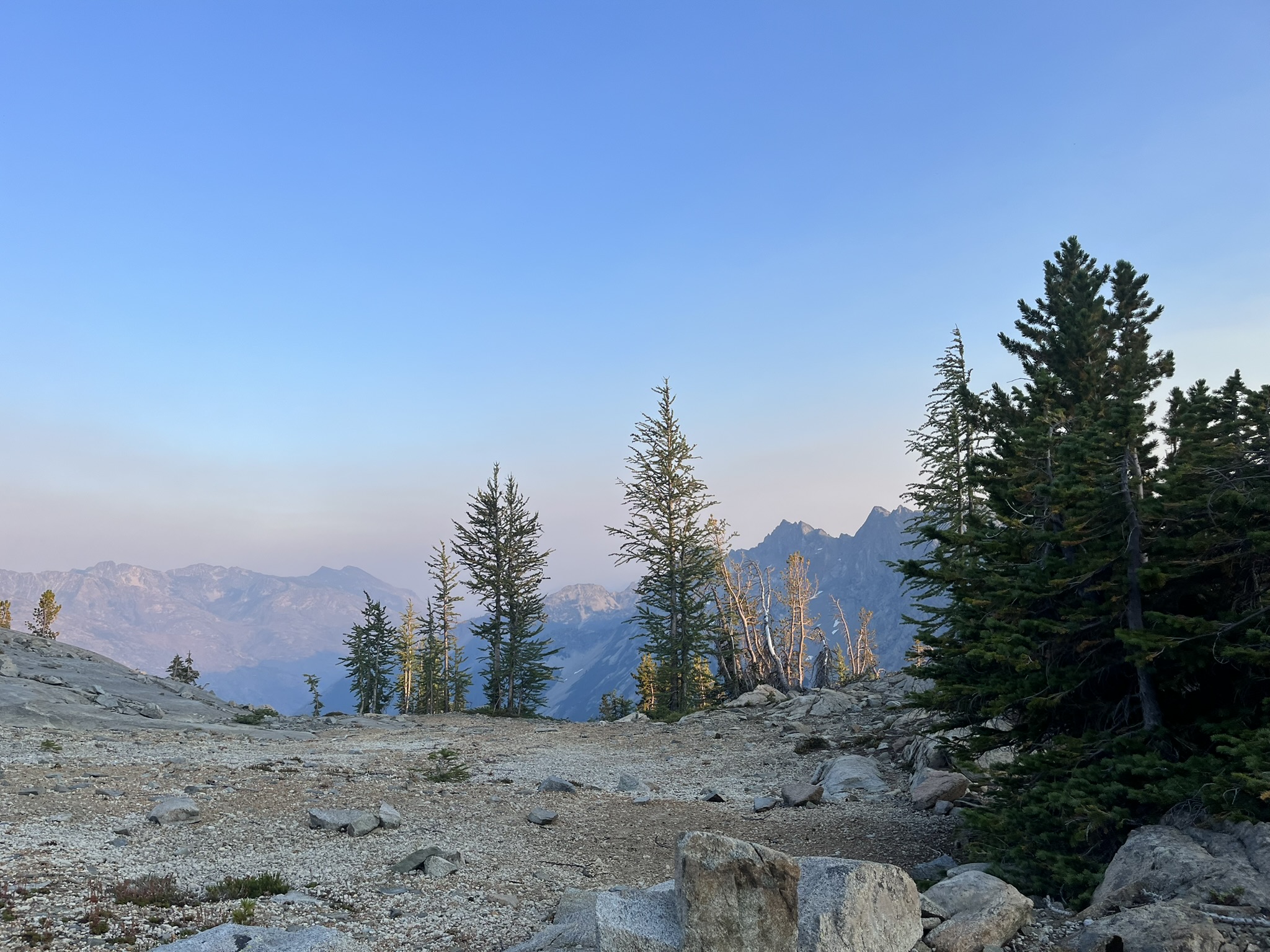
The sun dropped below the ridgeline and the basin went blue. The larch caught the last light — individual needles glowing against dark conifers and bare rock. Alpenglow touched the peaks to the west. The air cooled fast. I could feel it on my ears first, then my nose.
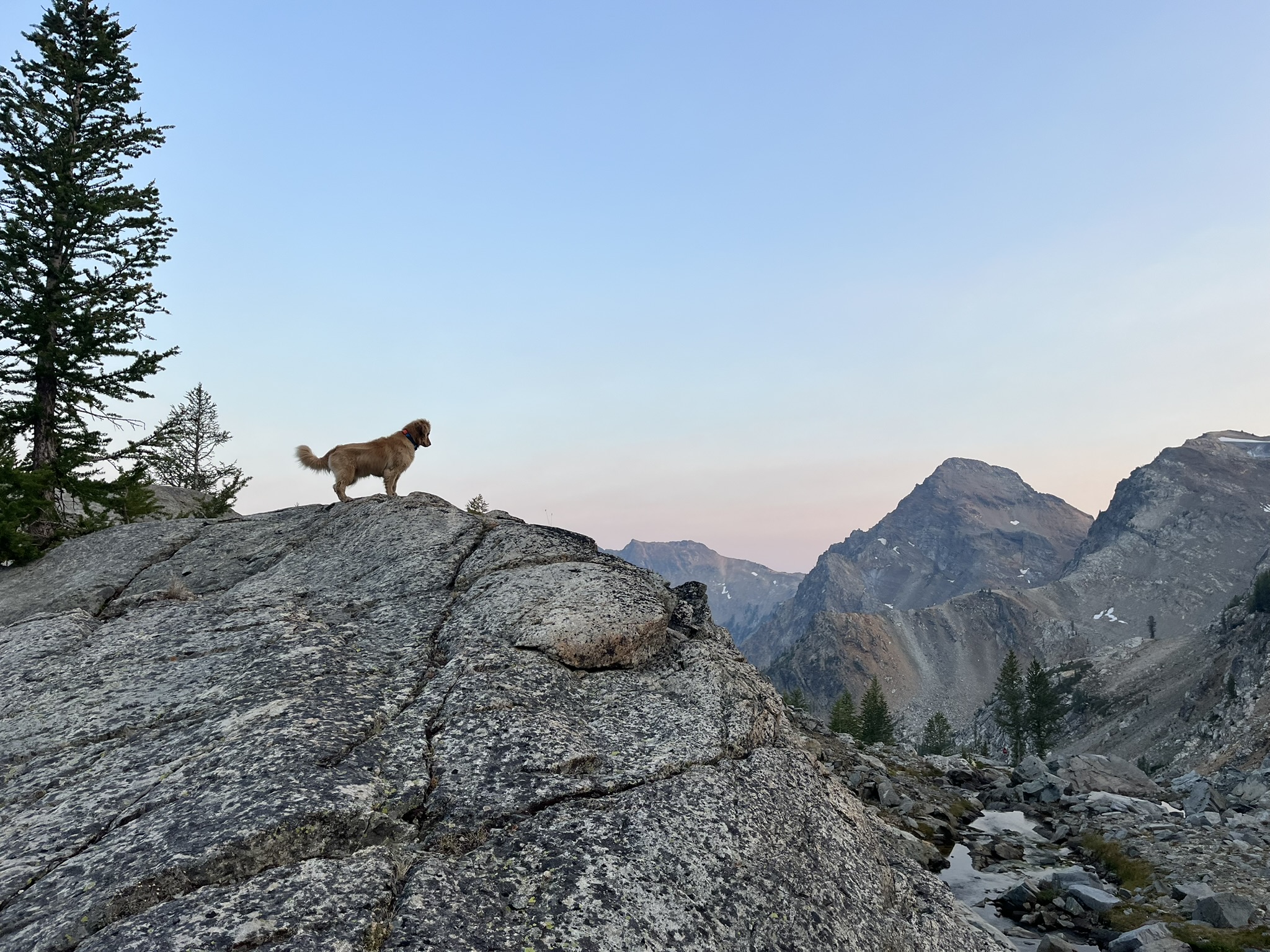
I scrambled up a granite slab above the lake and stood there with the whole basin spread out below me. My human was somewhere near the tent. I could smell the stove. But up here it was just me and the rock and the peaks going dark and the last color draining from the sky. The wind had stopped completely. The only sound was the waterfall.
I went back to the water one more time. The lake at dusk, completely still. Peaks reflected. A few larch going gold at the edges. I stood on the rocks with my reflection looking back at me from water that wouldn't move again until morning. This is the kind of place that makes you quiet whether you want to be or not.
The last thing I remember before sleep was the sound of the waterfall and the smell of cold stone and my human breathing in the tent next to me. The basin was completely dark except for stars.
Saturday Morning — Alpenglow
I woke before my human. The waterfall was still running. The first light hit the peak above camp — warm orange on cold granite, the kind of light that only lasts ten minutes and changes everything it touches. I lay on the rocks and watched it move down the face.
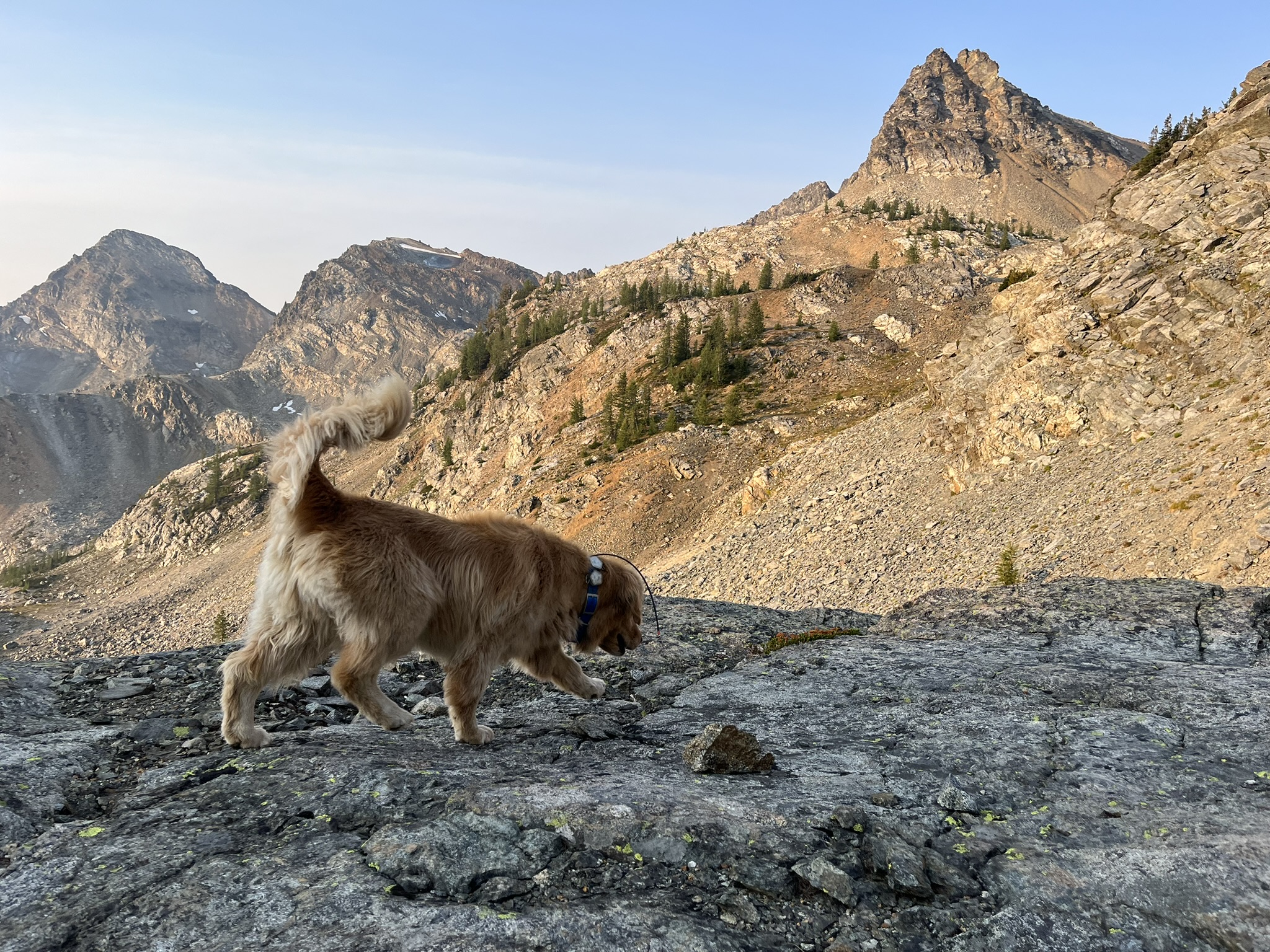
I got up and walked out onto the granite slabs above camp. The whole basin was catching the light now — gold on gray, the peak glowing, morning haze softening the edges. I moved across the rock with my nose working, reading what had come through in the night. Pika. Something larger — deer, maybe. The granite was cold under my paws.
The High Pass
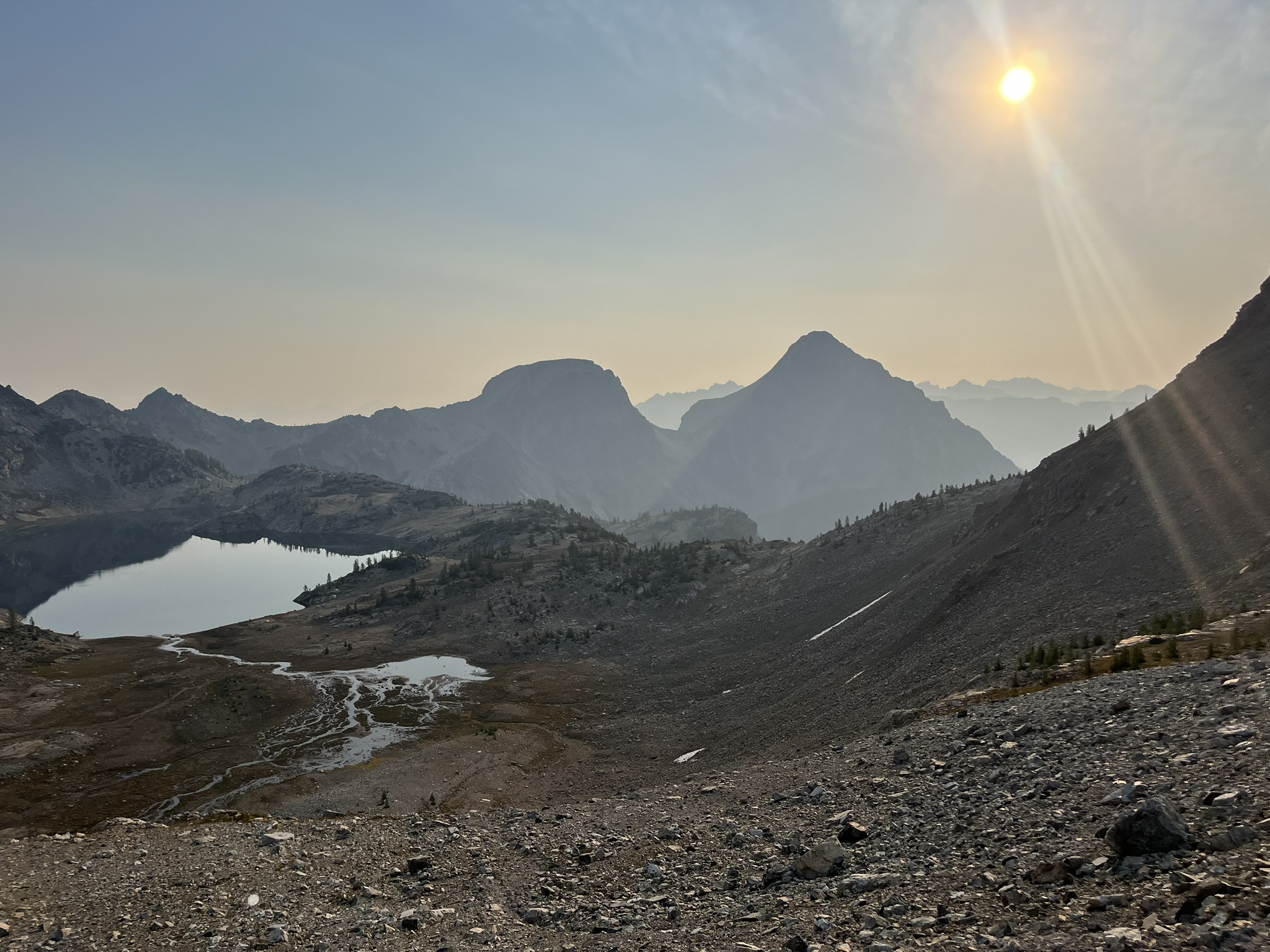
We packed up and climbed. The route went up through loose rock and scree to a pass at nearly 7,600 feet — the highest point of the trip. From the top I could see everything. A lake far below in a granite basin, more peaks stacking up into the smoke, the sun burning through haze. The whole Glacier Peak Wilderness laid out like a map you could walk on.
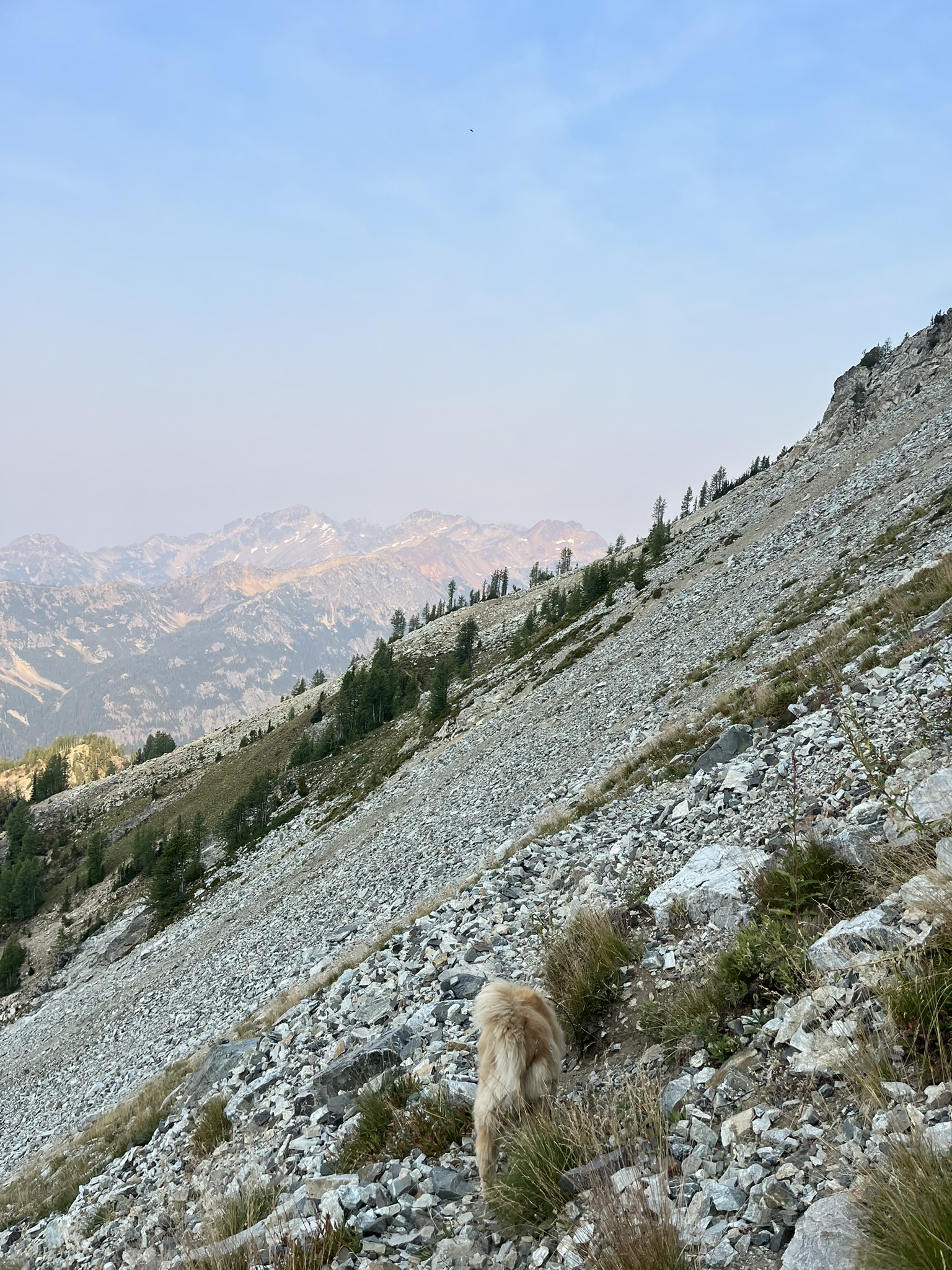
The descent was steep and loose. I picked my way down a scree slope — gray rock sliding under my paws, tufts of grass between boulders, the smoke thickening as we dropped toward the valleys. My human was behind me. I'm better at scree than he is. Lower center of gravity. Four-wheel drive.
The Descent
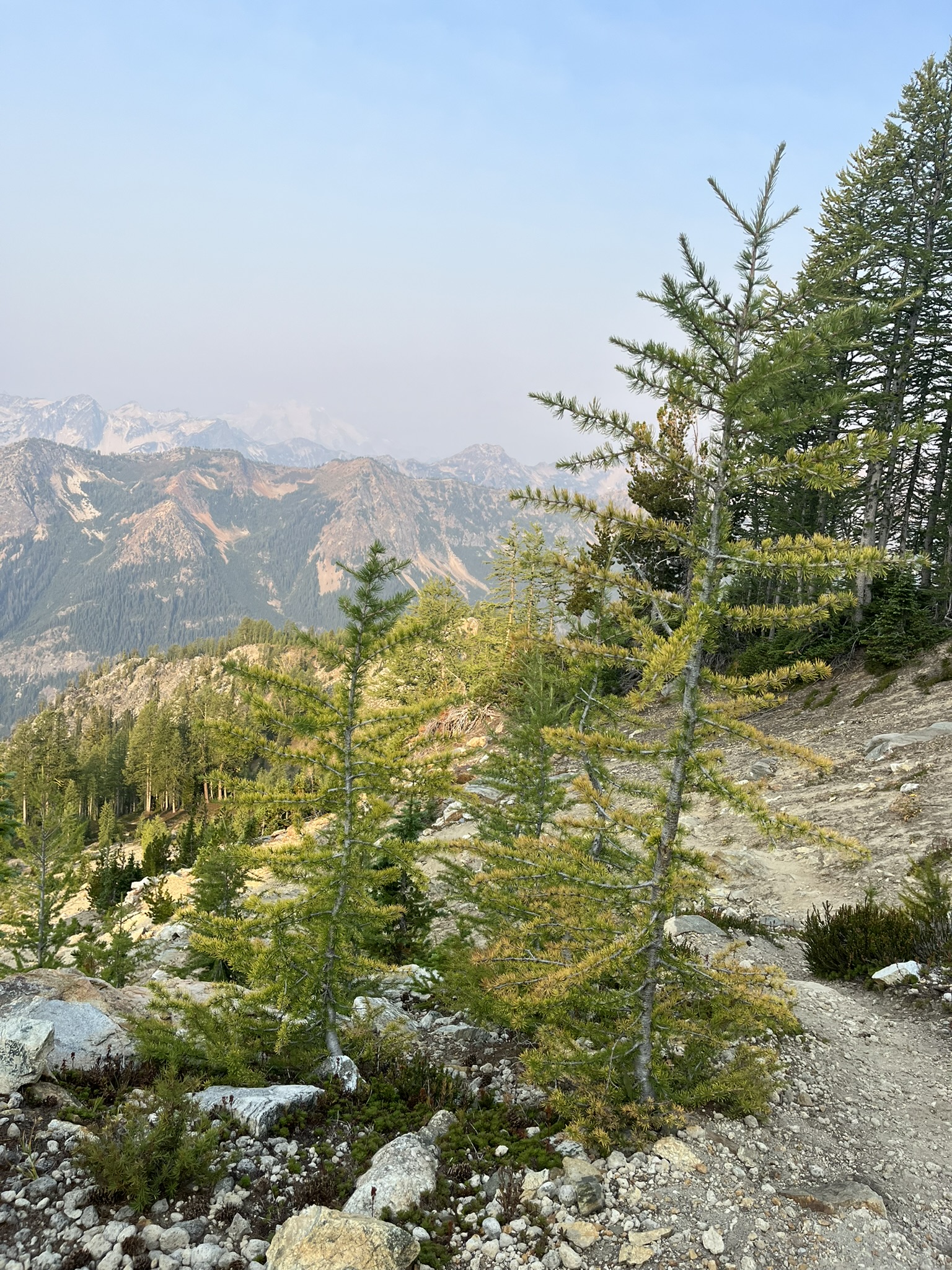
Below the scree, larch. The trees were just beginning to turn and the September light came through their needles like stained glass — gold and green against a smoky sky. The trail reappeared somewhere in here, a thin line of packed dirt through the rocks. I was happy to have it back. Off-trail is where the adventure lives but trails are where the legs rest.
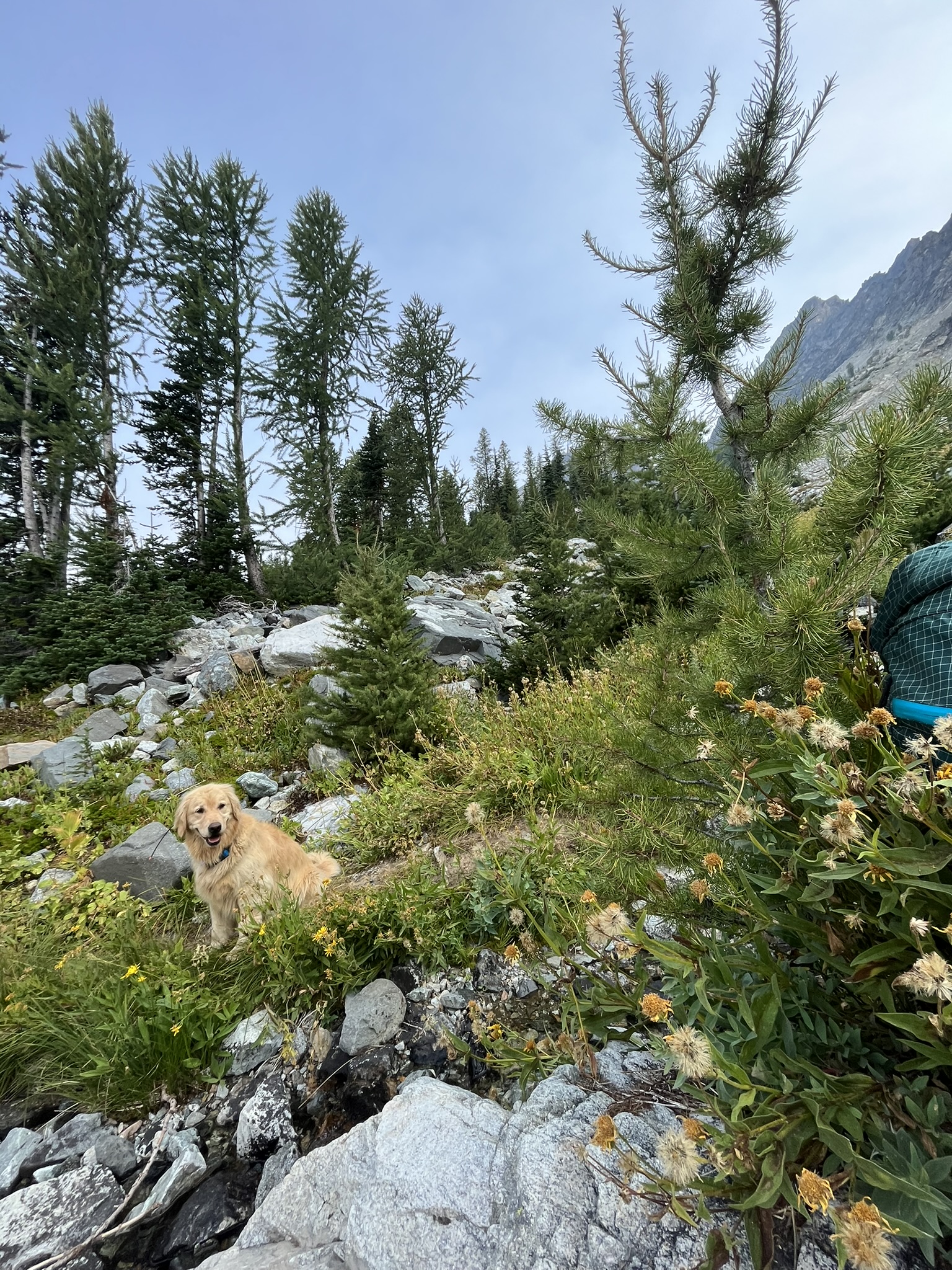
Lower still, we hit a creek drainage choked with wildflowers. Late-season blooms — orange and yellow, crowded between boulders and young conifers. I sat in the middle of it all with flowers at shoulder height, my human's pack visible behind me. The air was thick with the smell of crushed stems and wet earth and something sweet I couldn't name.
The Route
Two nights. 18.7 miles. 5,245 feet of gain. A meadow camp at dusk. A high camp beneath a peak that filled the entire sky. Alpine tarns I swam in alone. Granite slabs I stood on while the world went dark. A pass at 7,600 feet with the smoke of a burning season on every horizon.
The Carne High Route is off-trail through the kind of Cascade alpine that most people only see from summits. We walked through it. Camped in it. I swam in its lakes and slept next to its waterfalls and watched the light move across granite that doesn't care about anything. The smoke said the mountains were burning somewhere. But here, in this basin, everything was water and stone and cold air and silence.
My human navigated every foot of it. I was right there for all of it. That's the deal. He finds the way. I find the water.
Every single time.